
The Political Life of an Image
A famous image can eventually become difficult to see. Familiarity reduces it to a few recognizable elements: a raised flag, an advancing crowd, a woman personifying Liberty. The image is understood almost instantly, before the details of the painting have been examined or its historical contradictions considered.
Eugène Delacroix’s Liberty Leading the People has undergone precisely that transformation. It is now frequently treated as a universal illustration of revolution and is often mistakenly associated with the storming of the Bastille in 1789. Yet Delacroix did not paint an event from the first French Revolution. Nor did he simply record what happened in the streets of Paris in July 1830. He created something more complicated: a modern history painting in which eyewitness experience, classical allegory, political aspiration, and artistic calculation were deliberately combined.

Liberty Leading the People, Eugène Delacroix, 1830. Musée du Louvre. Public domain image via Wikimedia Commons.
The revolution that prompted the painting emerged from the political tensions of the Bourbon Restoration under Charles X. On July 25, 1830, Charles X signed four royal decrees, commonly known as the July Ordinances. They suspended freedom of the press, dissolved the recently elected Chamber of Deputies, altered the electoral system, and called for new elections under rules designed to strengthen royal control.
Journalists published in defiance of the ordinances. Printing presses were seized. Demonstrations escalated into street fighting, and barricades appeared across Paris during July 27, 28, and 29, remembered as Les Trois Glorieuses, or the Three Glorious Days. Charles X eventually abdicated, but the uprising did not establish a republic. Instead, Louis-Philippe of the House of Orléans became the constitutional “King of the French.” The political result was therefore more limited and ambiguous than the painting’s later reputation as an emblem of republican revolution might suggest. That ambiguity is essential to understanding Delacroix’s achievement.
At 32, Delacroix was already celebrated as one of the leading painters of French Romanticism, but his career had recently suffered a serious setback. His enormous and deliberately provocative Death of Sardanapalus had been harshly criticized at the Salon of 1827–1828. The events of July 1830 offered him an opportunity to return to the contemporary political subjects that had helped establish his reputation.
The resulting work was unusual even within his own career. According to Louvre curator Côme Fabre, it was the only major painting in which Delacroix depicted Paris and devoted a monumental canvas to the working people of his own country and time. Yet he did not organize the scene as a neutral report of street combat. He constructed a tightly controlled pyramid: the barricade and bodies form its base, Liberty supplies its center of gravity, and the tricolore crowns the composition. The painting combines several categories traditionally kept separate within academic art. It is at once a history painting, an allegory, an urban landscape, a collection of social types, and a record of human violence.
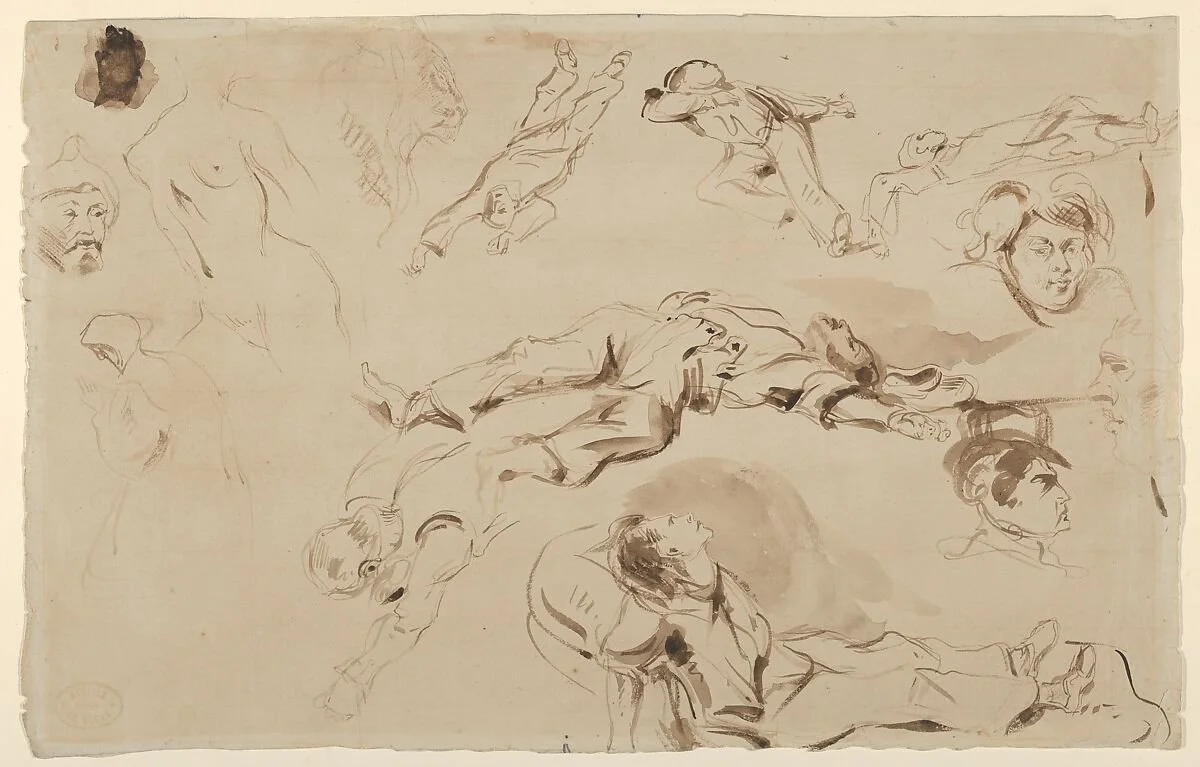
Figure Studies related to “Liberty Leading the People,” Eugène Delacroix, 1830. Pen and brown ink, brush and brown wash. The Metropolitan Museum of Art. Public domain.
After Delacroix completed the painting in December 1830, its political meaning continued to change. The work appeared at the Salon of 1831 and was purchased by the French state, but its revolutionary message soon made it politically inconvenient. It was removed from regular public view and remained subject to the changing attitudes of successive governments. It entered the Louvre only in 1874, during the early years of the Third Republic. A painting inspired by a revolution that installed another monarchy gradually became an emblem of the French Republic itself.
That history demonstrates that public memory is not created by artists alone. Governments, museums, exhibitions, textbooks, publishers, and later forms of mass media determine which images remain visible and how they are interpreted. The state purchased Delacroix’s painting as a celebration of the uprising that brought Louis-Philippe to power, then restricted its display when the same revolutionary energy appeared threatening. Decades later, a republican government presented it as part of a longer national movement toward liberty.
Liberty Leading the People endures not because its meaning has remained fixed, but because it has been repeatedly reinterpreted. Delacroix transformed the July uprising of 1830 into an image that outlived its immediate political circumstances. Later governments and institutions, in turn, helped recast a painting inspired by a revolution that produced another monarchy into a broader emblem of French liberty.
Its history reminds us that public memory is not simply inherited. It is shaped by the images a culture preserves, the meanings it assigns to them, and the moments in which it chooses to display them.
Une image peut devenir mémoire.
Jeu de français
How well do you know the Louvre’s collection? Test your knowledge by identifying ten works of art housed in the Musée du Louvre.
Subscribe to our newsletter to receive Art de vivre posts, information about courses, Conversation Café, special events, and other news from l’Institut français d’Oak Park.