
French Satire Then and Now
A key principle that arose from the 1789 Declaration of the Rights of Man and of the Citizen that France adopted after the Revolution was the freedom of speech with several limitations. Ruling governments and courts have imposed various restrictions on free speech rights since then yet the spirit of dissent to draw attention to issues has not been crushed. Long before the Internet provided a venue for anyone to put forth an essay, bon mot, or video questioning power or societal norms, the French found ways to express their views and garner public acclaim/notoriety while drawing the disapproving attention of governmental figures.
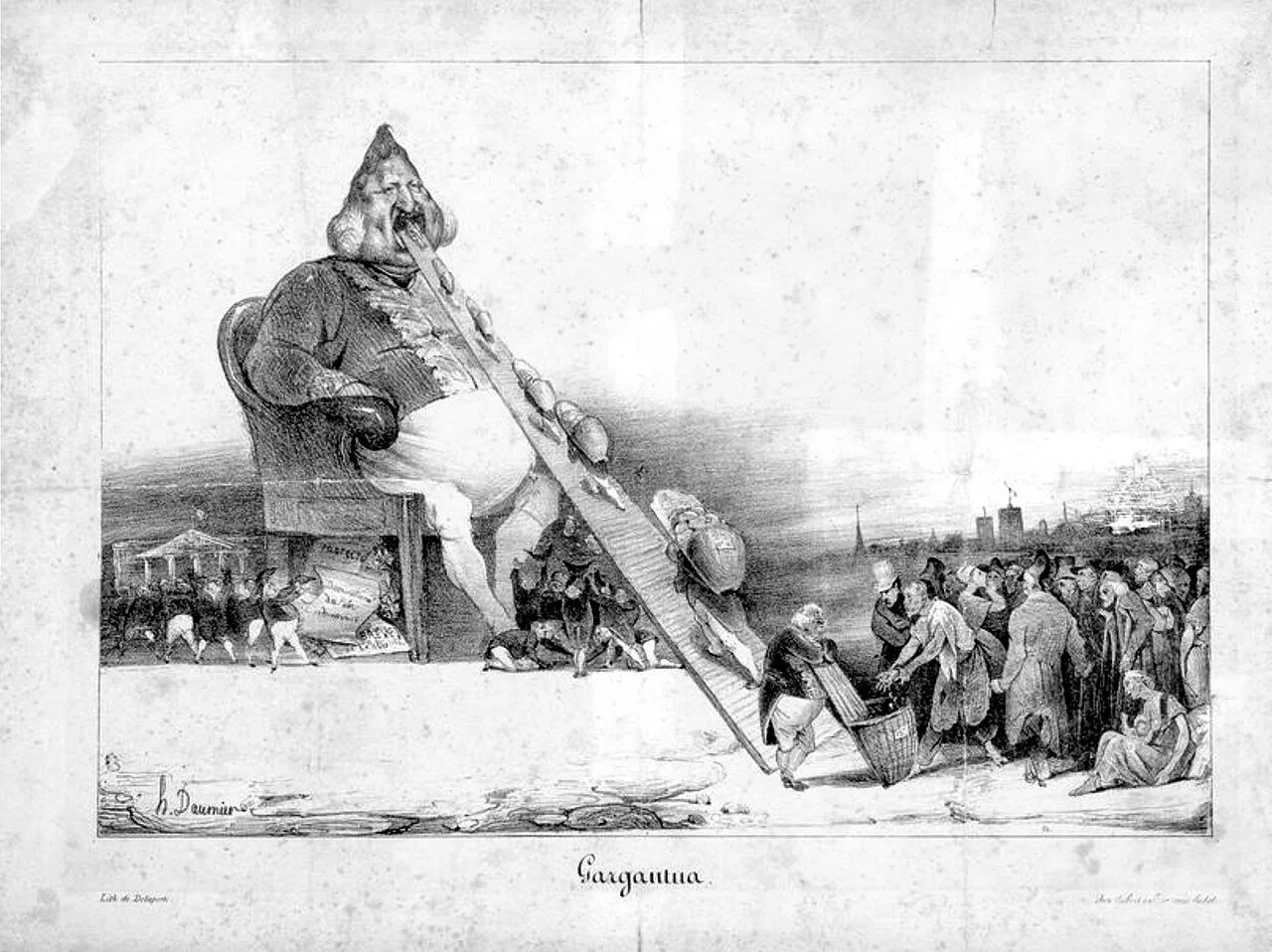
Gargantua, a lithograph by Honor Daumier, 1831. Image credit: Honoré Daumier, Public domain, via Wikimedia Commons
Honoré-Victorin Daumier, a 19th century artist who created several thousand lithographs, paintings, drawings, wood engravings and sculptures, was a young adult when the July Revolution of 1830 installed Louis-Philippe I as the ‘Citizen King’. The king’s stated attempt to follow a political ‘juste-milieu’ (middle road) between traditional monarchy and anarchy was perceived to be merely lip service by the working classes who felt that the ruler’s actions actually favored the bourgeoisie. An art student who had grown up in poverty, spent his adolescence working in a bailiff’s office and then as a bookshop assistant, Daumier found employment in the lithography studio of Zéphirin Belliard. He began to produce lithographs for several grassroots publications that cultivated a following among the working classes. Daumier’s views fell squarely on their side, and he used his artistic skills to craft pointed sketches and commentary that disdained the ruling class, its supporters, and those who benefited from their policies.

Dr. Clément François Victor Gabriel Prunelle, Deputy and Physician: from the series Célébrités du Juste Milieu (1832–35), painted terracotta. Musée d'Orsay, Paris, France. Image credit: Sailko, CC BY 3.0, via Wikimedia Commons
Despite the passage of a law regarding freedom of the press, Daumier quickly landed in court after one of his first caricatures of the king was published in La Caricature, a satirical journal, in December 1831. His image entitled “Gargantua” mocked the monarch as an obese being on a throne that was fed by a long line of supplicants while defecating awards and favors to his associates and the well-connected. Undaunted by his six-month prison stint, Daumier continued to create visual and verbal satirical works that resonated with many. He followed the founder of La Caricature, Charles Philipon, to a successor paper, Le Charivari, while submitting acerbic pieces to other publishers, many of whom found themselves targeted by the government while enjoying public appreciation. Daumier sculpted and painted clay caricatures of members of Parliament and other prominent figures that served as models for his lithographs and sketches. These came to be known as the Célébrités du juste milieu with the surviving 36 busts now at the Musée d’Orsay in Paris. Nearly a century after their creation, bronze versions of the Célébrités du juste milieu were forged after his death and can be viewed at the Art Institute of Chicago. Daumier also achieved a modest degree of recognition as a serious artist, participating in the 1849 and 1850 Paris Salons and other exhibitions, but was dependent on political art to support himself and his family.
Two television shows of late 20th century France pointedly took aim at the country’s politicians and public figures through puppetry. On public television station TF1, Le Bébête Show was clearly inspired by the Muppet Show but with a different mission. In the series, marionettes resembling prominent French politicians crossed with Muppets and/or animals with exaggerated characteristics convened at a fictional bar as the 1988 presidential elections got underway. A haughty frog named Kermitterand poked fun at President François Mitterand; former Prime Ministers Raymond Barre and Jacques Chirac (who succeeded Mitterand as President) were depicted as French versions of Muppets Fozzie Bear, with off-target jokey comments, and a rather uptight Sam the Eagle; and Pencassine, a modification of the name Bécassine from a character in a children’s comic book, was a vampire in traditional Breton clothing who spoke with a German accent as a spoof of far-right leader Jean-Marie LePen. Le Bébête Show initially enjoyed a 30% audience share with its irreverent portrayals that the puppets’ namesakes did not uniformly enjoy.
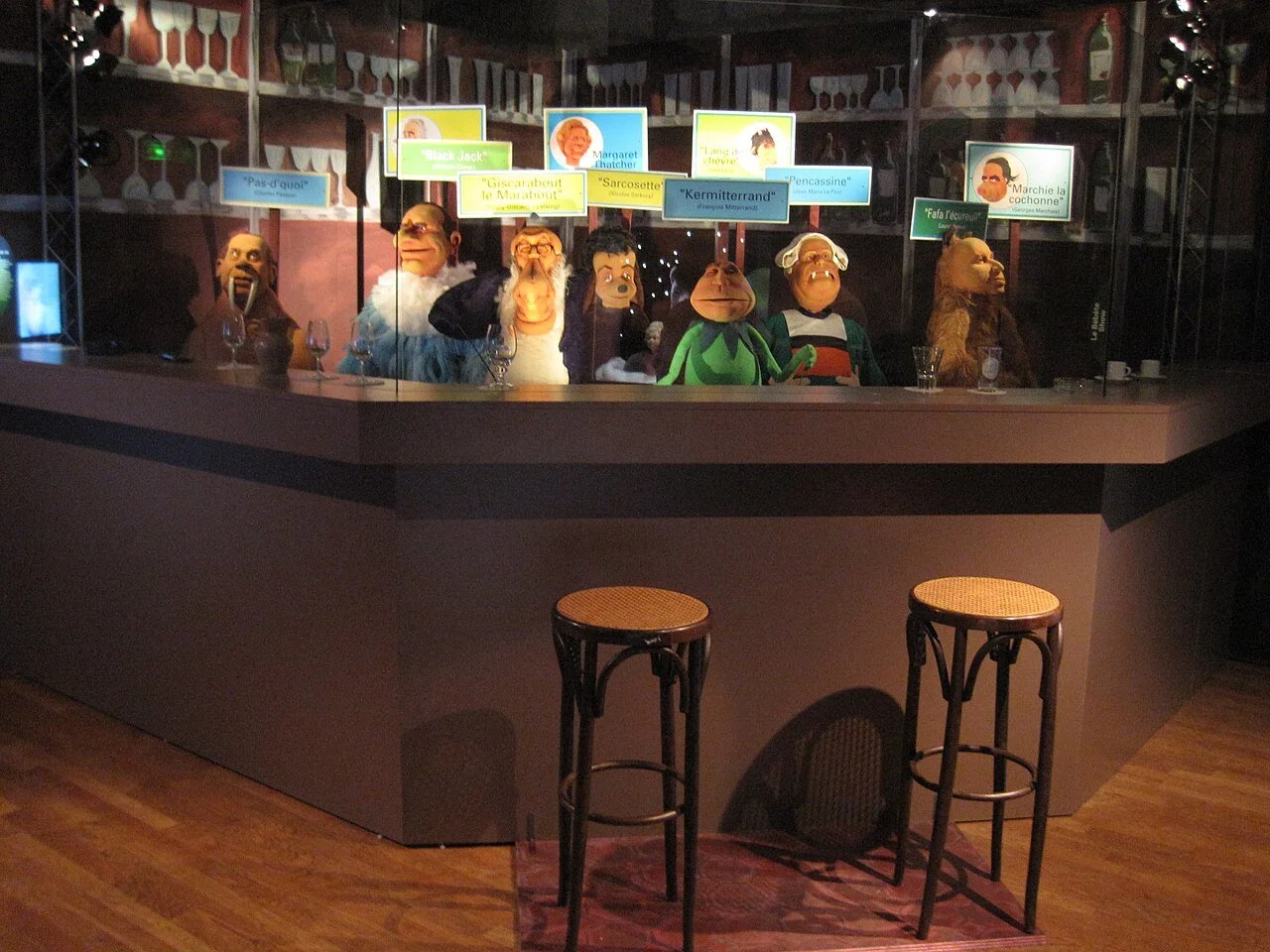
Le Bébête show - Puppet exhibition at the Citadel of Besançon, France, June 2013. Image credit: Arnaud 25, CC BY-SA 3.0, via Wikimedia Commons
Also in 1988, Les Arènes de l'info, made its début on cable channel Canal+ as a satire of French news shows. Its characters were puppet versions of actual hosts Patrick Poivre d’Arvor and Anne Sinclair, then Christine Ockrent, who would anchor each segment and interview puppet versions of politicians, entertainers, athletes, and others. Inspired by the British show Spitting Image, Les Arènes de l'info parodied public figures, French society, current events, and the media in sketches and caricatures. Competition from Le Bébête Show contributed to a slow start for the program, which evolved into Les Guignols de l’info in 1990. The following year, it offered a lighthearted alternative to the networks’ coverage of the Gulf War and built its viewership base. The program’s success even subjected it to accusations of influencing the 1995 elections through biased portrayals of presidential candidates. Even as key members of the writing and production teams turned over from time to time, Les Guignols de l'info continued to air until 2018.
In contrast with the experience of Daumier, Philipon, and their contemporaries, the creators, writers, and producers of Le Bébête Show and Les Guignols de l'info were not prosecuted by the government. Jean-Marie LePen successfully sued to require changes to the Pencassine character - a far cry from imprisonment and the forced shutdowns that had been imposed in the earlier years following the French Revolution and evidence that the freedom of speech and of the press that had been envisioned in the Declaration of the Rights of Man and of the Citizen have evolved and still endure.
Jeu de français
French satirists considered all parts of society to be fair game starting with politicians who most obviously held (or wanted to hold) power and encompassing businesspeople, media figures, athletes, cultural icons, and people in the news for short or long durations. How well do you know figures from the decades since the Citizen King loosened his predecessor’s restrictions on free speech? Try matching the famous French people from all walks of society to the decade of their birth and the field that made them household names.
Subscribe to our newsletter to receive Art de vivre posts, information about courses, Conversation Café, special events, and other news from l’Institut français d’Oak Park.