

Inventing the Meter
A unit of measurement can become so familiar that its history disappears. A meter seems less like a human invention than a neutral fact: fixed, universal, and independent of politics. Yet the meter emerged from a particular historical moment, when revolutionary France attempted to replace a confusing inheritance of local measures with a standard grounded in reason, nature, and equality.
Before the Revolution, France did not measure with a single uniform system. Units could vary by region, city, trade, and even by the object being measured, creating practical problems for commerce, taxation, land surveys, and administration. Calls for reform appeared in the cahiers de doléances of 1789, where grievances about weights and measures joined a broader demand to make public life more consistent and less dependent on inherited privilege.
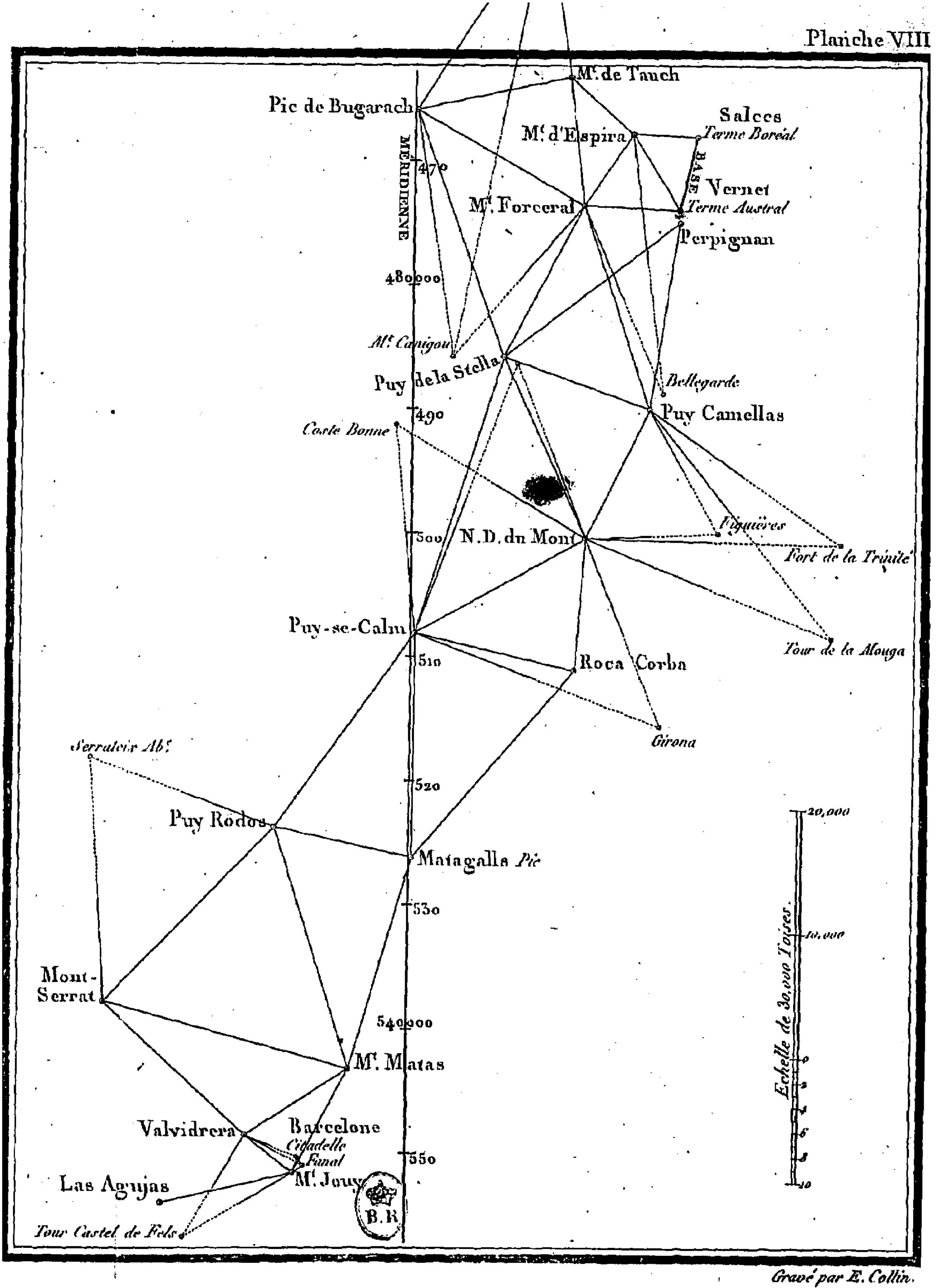
Delambre and Méchain, Base du système métrique décimal, 1806. Bibliothèque nationale de France/Gallica. Public domain via Wikimedia Commons.
In March 1791, the Académie des sciences recommended that the new unit of length be derived from the Earth itself. Rather than define it through a royal standard or an object associated with one place, the meter would equal one ten-millionth of the distance from the Equator to the North Pole along a meridian. The principle was deliberately universal: in theory, nature could provide the same standard to anyone. The choice also reflected an Enlightenment confidence that reason could replace accumulated custom.
Turning that idea into an actual measurement required an extraordinary undertaking. Jean-Baptiste Delambre and Pierre Méchain were assigned to survey an arc of the Paris meridian between Dunkirk and Barcelona. Beginning in 1792, they used triangulation, astronomical observations, and carefully measured baselines to determine a portion of the meridian precisely enough that the larger distance could be calculated. Their work linked distant elevated points into an invisible geometric network across France and into Spain.
The expedition unfolded while France itself was being transformed. Revolution gave way to political instability and war, travel became difficult, and scientific instruments could attract suspicion from communities already alert to spies and enemies. Delambre and Méchain were trying to establish a universal standard while governments and political loyalties around them were changing. The contrast between the order of geometry and the disorder of revolutionary life became part of the project.
Their work also exposed a contradiction at the heart of the meter. The new unit was intended to rise above local custom and political authority, yet its creation depended on French institutions, government decrees, scientific expertise, and years of difficult fieldwork. A measure imagined as universal had to be produced through a very particular national history.
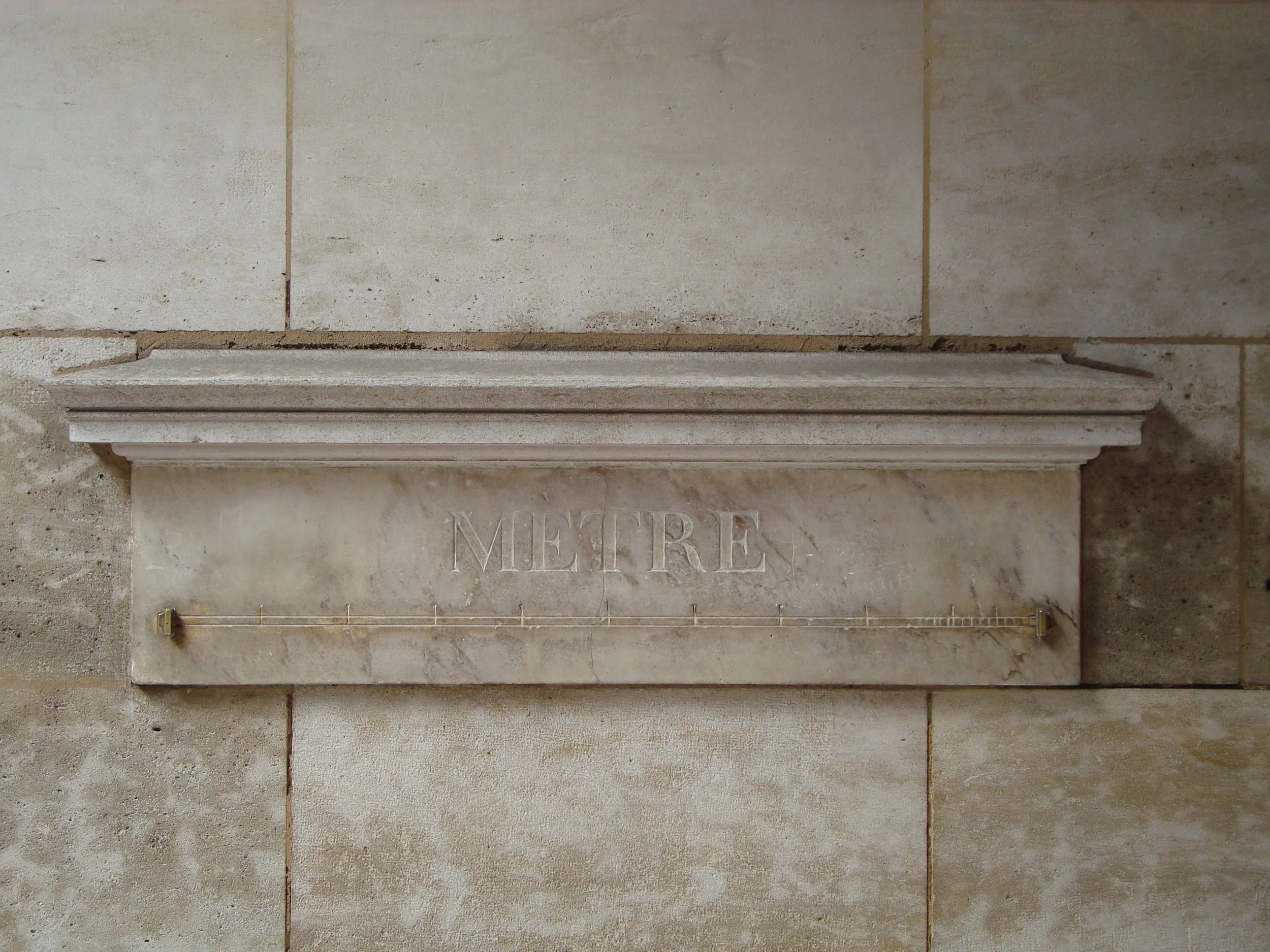
Mètre étalon, rue de Vaugirard, Paris. Photo by LPLT. CC BY-SA 3.0 via Wikimedia Commons.
France formally established the decimal metric system in 1795, before the meridian survey had been fully completed. Provisional standards circulated, and physical examples were placed in public spaces so that people could begin to understand an unfamiliar unit. A surviving marble mètre étalon on the rue de Vaugirard in Paris still shows how an abstract scientific definition had to be translated into something ordinary citizens could actually see and use.
In 1799, a definitive platinum meter was deposited in the Archives of the Republic. But creating a standard did not mean that people immediately abandoned familiar ways of measuring. In 1812, Napoleon permitted modified customary measures to return for everyday use, and the metric system did not become compulsory throughout France until 1840. The delay is a reminder of the difficulty in erasing cultural traditions with more rational systems.
The later history of the meter continued the same search for a standard independent of any single object. Scientists eventually moved beyond the platinum bar and toward definitions that could be reproduced through physical phenomena and, later, fundamental constants. Since 1983, the meter has been defined through the distance light travels in a vacuum during a specified fraction of a second.
The reference has changed from the Earth to light, but the ambition remains recognizable. Revolutionary France sought a measure that would be rational, shared, and capable of extending beyond local custom. The meter’s history reminds us that even the most ordinary standards can carry the imprint of the political and intellectual worlds that created them. What appears neutral today may still preserve the history of the choices that made it possible.
Mesurer, c’est aussi choisir une manière de voir le monde.
Jeu de français
Put your knowledge of units of length to the test with this quick measurement quiz.
Subscribe to our newsletter to receive Art de vivre posts, information about courses, Conversation Café, special events, and other news from l’Institut français d’Oak Park.