

La Marseillaise : The War Song That Became a French Symbol
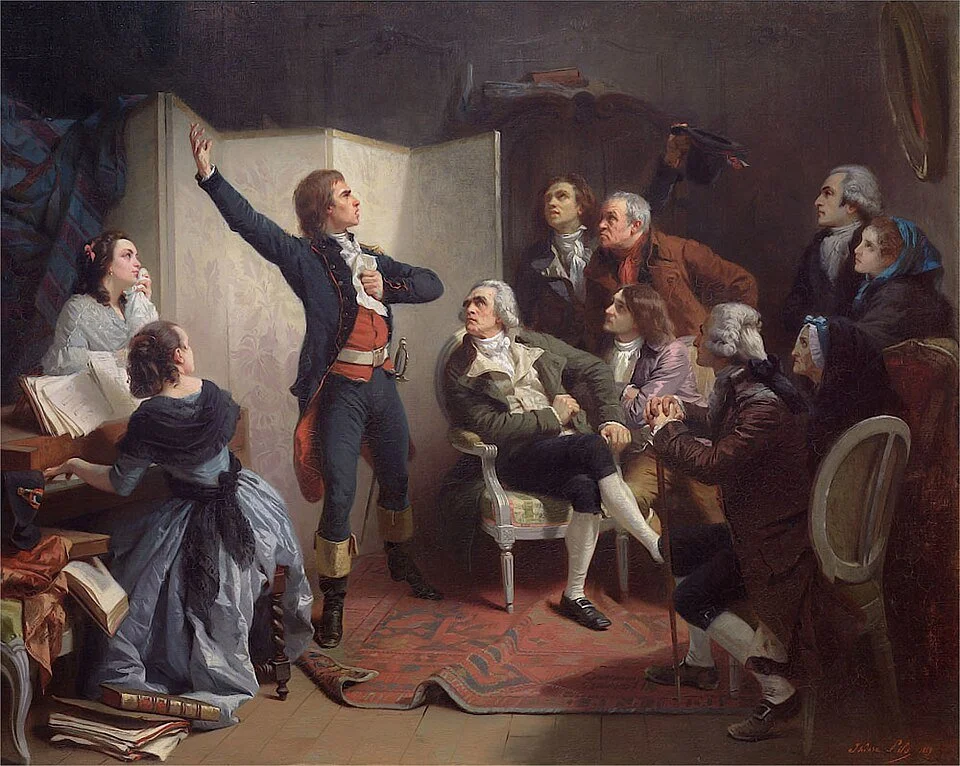
Rouget de Lisle chantant La Marseillaise, Isidore Pils (1849) — Source :via Wikimedia Commons / Domaine public
Few national anthems are as instantly recognizable as La Marseillaise, whose call to “les enfants de la Patrie” (‘the children of the fatherland’) rings out during official ceremonies, sporting events, and national commemorations, starting with the July 14 celebration, for example. Indeed, the song evokes one of the greatest moments in French history: the French Revolution (1789–1799), from which it directly originated. Adopted as the official national anthem on February 14, 1879, and enshrined in the French Constitution, it nevertheless has a far more tumultuous history than its status would suggest. It was not composed in Marseille and was not originally intended to become a national anthem.
The story begins in the spring of 1792, when revolutionary France declared war on Austria and found itself facing the threat of invasion by monarchist Europe. In Strasbourg, near the German border, Mayor Philippe-Frédéric de Dietrich called for a song capable of galvanizing the troops stationed in the city. On the night of April 25–26, Claude Joseph Rouget de Lisle, a young captain in the engineering corps who was also an amateur musician and poet, wrote the lyrics and music for what he titled the “Chant de guerre pour l’armée du Rhin.”
As a revolutionary war song, La Marseillaise is at once a call to arms against foreign invasion, a patriotic appeal for general mobilization, and a hymn to freedom directed against tyranny. It conveys a political message aimed at defending the homeland and the sovereignty of the French people against the monarchy, which, incidentally, collapsed shortly thereafter, on August 10, 1792. Les “despots” and “tyrants” are explicitly denounced in the song, which thus accompanied the birth of the Republic and remains one of its symbols to this day, embodying the values of freedom, resistance, and unity of the French people.
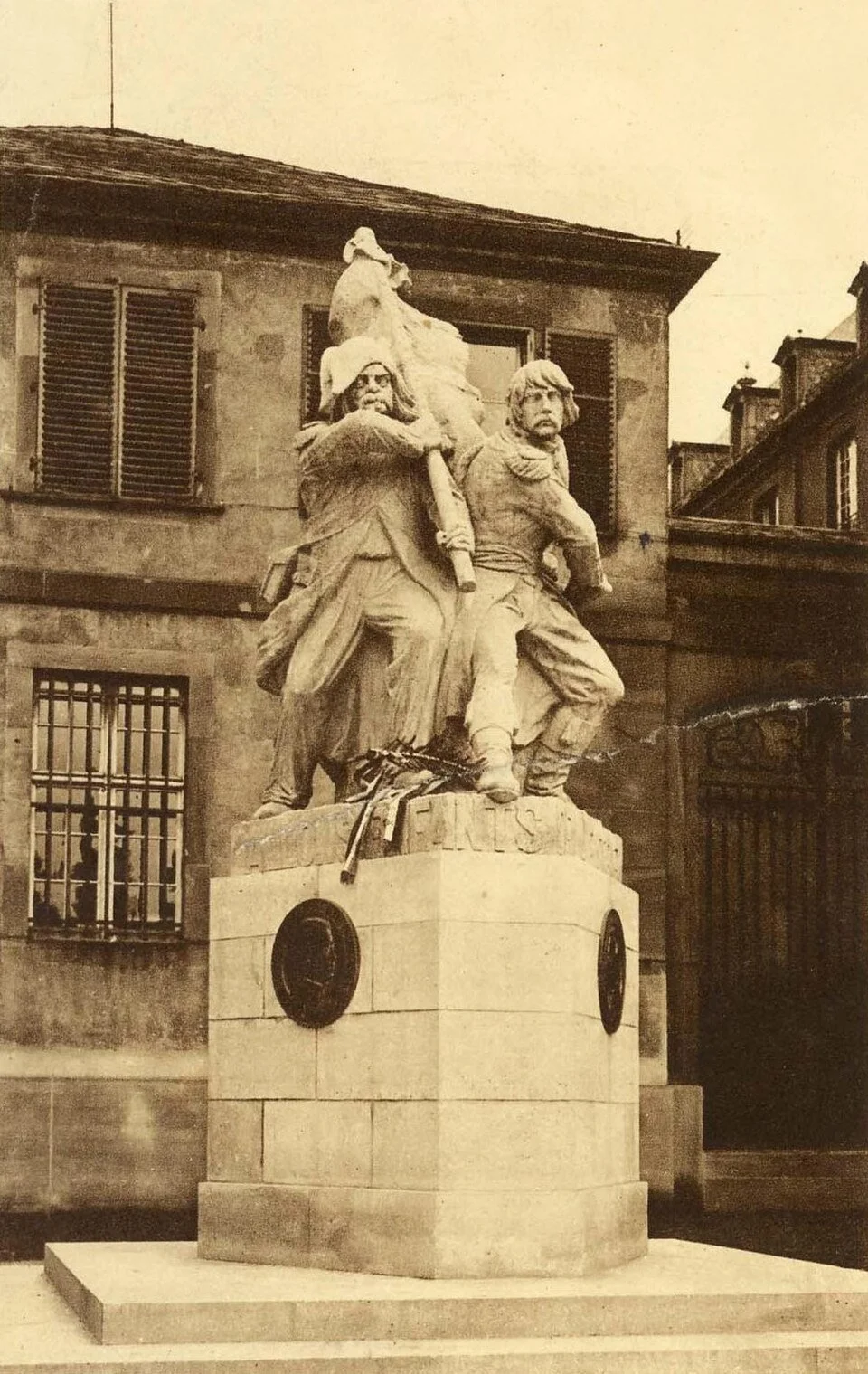
Strasbourg : monument de la Marseillaise (1928), sculpture d'Alfred Marzolff — Source : BNU / via Wikimedia Commons / Domaine public
However, its political history was not a straightforward one. Designated the national anthem in 1795, it remained France’s anthem until the establishment of the First Empire in 1804, when Napoleon Bonaparte (1769–1821) preferred more subdued tunes less associated with the overthrow of the regime, such as “La Marche consulaire” or “Veillons au salut de l’Empire.” Soldiers nevertheless continued to sing it on the battlefields, right up to the final battle at Waterloo in 1815. Abandoned during the Bourbon Restoration of the monarchy, it was revived in 1830 by the insurgents of the Three Glorious Days (‘the July Revolution of 1830’), the second French Revolution, that brought Louis-Philippe I to the throne. Hector Berlioz, the famous French composer, then created a new orchestral arrangement so that it could be performed by an orchestra. The new king, however, preferred a more subdued song, La Parisienne, and La Marseillaise was once again banned from public venues.
It was the Third Republic that restored the song to its place on February 14, 1879, by making it the national anthem. The following year, the government designated July 14 as la Fête nationale (known in English as Bastille Day), thereby establishing a lasting link between the anthem and the republican values of liberty and equality, with the aim of anchoring the values of the Republic through symbols, rituals, and other collective practices.
The same pattern recurred during World War II (1939–1945), under the German Occupation and the collaborationist Vichy regime (1940–1944), when singing the national anthem was banned and replaced by the song “Maréchal, nous voilà!”. But the Resistance adopted it as early as 1940, and again in response to General de Gaulle’s call in 1942. Its status was finally confirmed by Article 2 of the Constitution of October 27, 1946, establishing the Fourth Republic, and then by Article 2 of the Constitution of October 4, 1958, which founded the Fifth Republic. Together with the tricolor flag and the motto “Liberté, Égalité, Fraternité” these provisions made it an emblem of the French Republic.
The lyrics themselves regularly spark debate.
Premier couplet (First Verse)
Allons enfants de la Patrie,
Le jour de gloire est arrivé !
Contre nous de la tyrannie,
L'étendard sanglant est levé, (bis)
Entendez-vous dans les campagnes
Mugir ces féroces soldats ?
Ils viennent jusque dans vos bras
Égorger vos fils, vos compagnes !
English translation
Arise children of the fatherland,
The day of glory has arrived!
Against us tyranny's
Bloody standard is raised, (repeat)
Do you hear, in the countryside,
The roaring of these savage soldiers?
They are coming right into your arms
To cut the throats of your sons, your women!
Refrain (Chorus)
Aux armes, citoyens,
Formez vos bataillons,
Marchons, marchons !
Qu'un sang impur
Abreuve nos sillons !
English translation
To arms, citizens,
Form your battalions,
Let us march, let us march!
May impure blood
Water our furrows!
Written against the backdrop of an existential military threat, the verses call on citizens to take up arms and speak of “impure blood” that would water the furrows, language that many find difficult to reconcile with contemporary sensibilities. According to some interpretations, these verses refer neither to foreign blood nor to any particular ethnic origin. Rather, they refer to certain nobles, who were supposed to have “pure blood” yet betrayed France by participating in the Counter-Revolution. It is worth recalling that in France, and more broadly in Western Europe, the Ancien Régime was built on the idea of a biological difference between the nobility, who were “well-born,” and the rest of the population, whereas the revolutionaries sought precisely to abolish these privileges so that all might be born free with equal rights.
Throughout history, artists have regularly reimagined the anthem. In 1979, the famous singer Serge Gainsbourg released a reggae version, “Aux armes et cætera”, which resonated with the general public and earned him the first gold record of his career in 1979. Beyond its commercial success, this interpretation invites listeners to hear the anthem’s message in a new light and to reclaim republican symbols. Gainsbourg chose reggae because he saw it as the most popular and emancipatory music of his time, and his move stood in opposition to the racial categorization he himself had experienced since childhood. Born into a Jewish family that could have fallen victim to the Holocaust, he understood the subversive power of the song and was thus able to unite racialized minorities under the tricolor flag.
In the unique political and cultural context of 1970s France, the song provoked an enormous uproar, particularly in nationalist and military circles, which accused the singer of treason and of insulting the national anthem. Faced with this criticism, Gainsbourg fully embraced his provocative approach, answering that reggae is a revolutionary music, as is La Marseillaise. The controversy did not prevent the song from becoming one of the greatest hits of his career. Other artists drew inspiration from these lyrics of freedom and resistance, notably in 1967 when the Beatles used the melody of “La Marseillaise” as the introduction to “All You Need Is Love,” a song calling for universal love.
The French people’s relationship to the national anthem has also been enshrined in law. In 2003, a law was enacted to punish demonstrating contempt for the national anthem, a measure that followed the booing heard during the historic first France-Algeria friendly match on October 6, 2001. Since the 2019 law, known as the School of Trust law (loi pour une école de la confiance), the lyrics must be displayed in all classrooms so that new generations of students continue to learn the patriotic song.
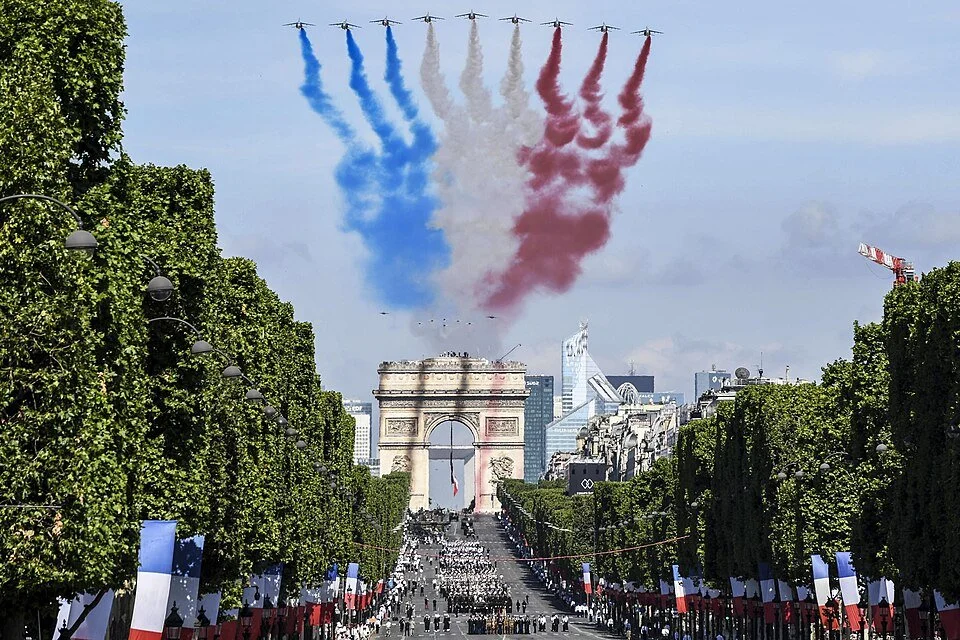

Survol des Alphajets lors du défilé du 14 juillet 2017 à Paris — Photo : Chief Petty Officer Michael McNabb via Wikimedia Commons / Domaine public
The emotional power of the anthem has once again been evident in recent years. In November 2015, four days after the November 13 terrorist attacks that struck Paris, and notably the Stade de France, spectators at Wembley Stadium in London sang “La Marseillaise” alongside French fans before a friendly match between England and France, at the initiative of the Football Association and the British government.
The anthem is most often heard by an international audience at sporting events. When Paris hosted the Summer Olympic Games in 2024, the opening ceremony featured a performance by mezzo-soprano Axelle Saint-Cirel, who sang from the roof of the Grand Palais, a deliberate gesture that framed the anthem within a vision of the capital that was both rooted in heritage and creative.
Keep your ears open for a performance of “La Marseillaise” worthy of the name: Mireille Mathieu is ready to sing it for you with all the power it deserves.
Subscribe to our newsletter to receive Art de vivre posts, information about courses, Conversation Café, special events, and other news from l’Institut français d’Oak Park.