
Rediscovered
By 1770, King Louis XV had already reigned over France for nearly half a century from Versailles. Budgetary pressures from a series of wars, profligate spending by the royal court, financial mismanagement, and policies that fostered economic stagnation were exacerbated by resistance from regional parliaments and the populace regarding tax payments. However, a vibrant jumble of social classes coexisted in Paris, where the upper echelons jockeyed to curry favor with royals to procure noble status that exempted them from taxes, opened pathways for their sons into positions within the Catholic church, French military, and high-ranking civil service, and afforded them lifestyles characterized by public displays of sophistication and cultural activities such as private salons, theatre, and the literary arts.
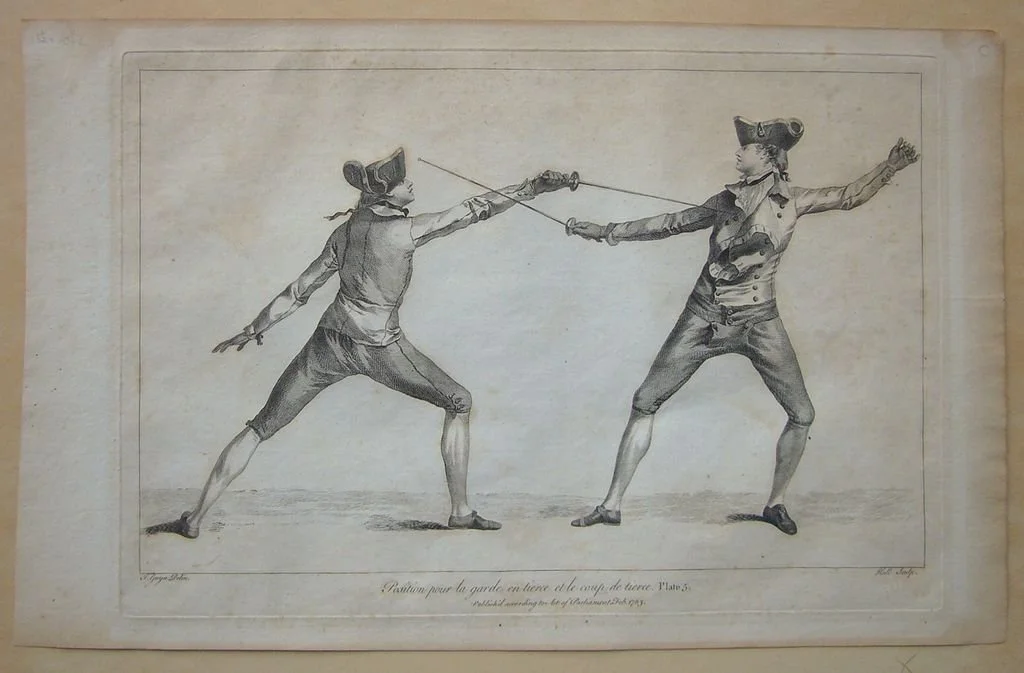
Angelo Domenico Malevolti Fencing Print from 1763. Image credit: Charlesjsharp (talk) (Uploads), Public domain, via Wikimedia Commons
Within this slice of Parisian society moved a multitalented man named Joseph Bologne, Chevalier de St. Georges. He achieved initial fame as a teenager upon defeating a well-known fencing master and was equally if not more gifted as a violinist and composer. Bologne made his debut in 1769 in the Concert des Amateurs orchestra founded by composer François-Joseph Gossec and was named concertmaster two years later. In 1772 he revealed another facet of his talents by performing two violin concertos that he had composed. He was named conductor of the orchestra the next year when Gossec took a new position, and became increasingly admired and well-known throughout Paris, France, and Europe. Queen Marie-Antoinette occasionally attended performances by the orchestra and invited Bologne to play at private gatherings at Versailles. Wolfgang Amadeus Mozart and Bologne were guests staying with a host in France for several months in 1778. He conducted the premiere of Franz Joseph Haydn’s Paris symphonies.
Bologne’s beginnings did not foreshadow his ascent into this level of 18th century French society. Born in 1745 to a French sugar plantation owner in Guadeloupe named Georges de Bologne and Nanon, one of his enslaved workers, Joseph was sent to boarding school in France as a child. His parents reclaimed him after moving to Paris shortly before he turned ten and just before Georges was granted a royal title that gave him the right to add ‘de Saint Georges’ to the family name. The details of young Joseph’s early violin and musical instruction are unclear, but during his teenage years, he was trained in the art of fencing by the master Nicolas Texier de La Boëssière and in the equestrian arts in the nearby royal equestrian academy called the Salle du Manège. He was named a chevalier upon finishing his studies and took the name ‘Chevalier de St. Georges’, but could not inherit his father’s noble status under French law. However, the Chevalier’s fencing prowess allowed him to cross paths and foster relationships with Domenico Angelo, a legendary Italian fencing master, and Louis Philippe II, who would later become the Duc d’Orléans.

Monsieur de St George (1745-1799), West Indian fencer and violinist. Reproduction of mezzotint, original published 1788, National Portrait Gallery, London. Image credit: Mather Brown, William Ward, Public domain, via Wikimedia Commons
Over the course of the 1770s, the Chevalier composed two suites of six string quartets, twelve violin concertos, a trio of sonatas for violin and piano, a half-dozen sonatas for two violins, two symphonies, and numerous other works for orchestra and ensembles. His musical compositions bridged the Baroque and Classical periods and were influential in the emergence of the symphonie concertante form. Other composers dedicated their creations to the Chevalier in recognition of his musical gifts and influence, and John Adams, after a diplomatic visit to France in 1779, noted in his diary that Bologne was “the most accomplished Man in Europe in Riding, Running, Shooting, Fencing, Dancing, Music.” Yet his qualities were insufficient in the eyes of several singers who cited the Chevalier’s heritage in a successful petition to block his nomination as the director of the Paris Opera in 1776. He was also prohibited from receiving any inheritance upon his father’s death in 1774. Bologne began to compose music for operas with some degree of success and earned a steady income as the music director for private theater of Madame de Montesson, the wife of his old friend’s father, Louis Philippe I, who engaged the Chevalier as Lieutenant de Chasse at his hunting lodge east of Paris.
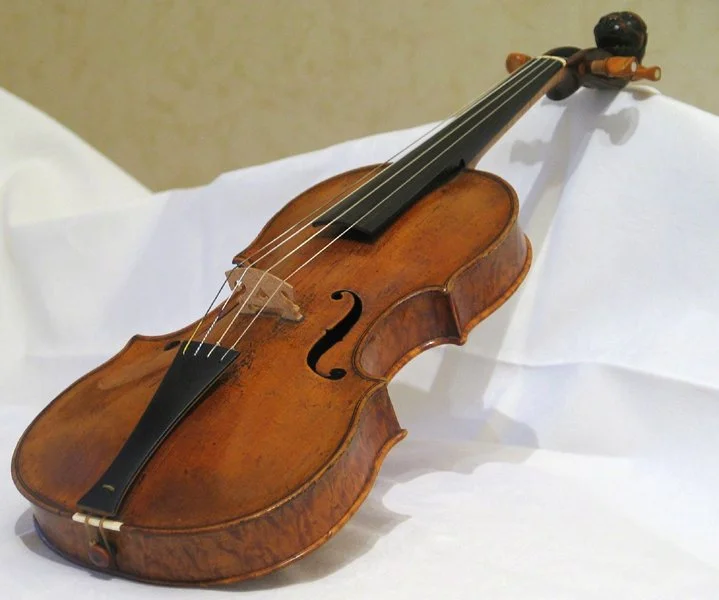
7/8 violin from 1658 by Jakob Stainer (Absam Tirol). Image credit: User:Frinck51, CC BY-SA 3.0, via Wikimedia Commons
Mounting royal financial troubles caused the Concert des Amateurs to cease operating but Louis Philippe II responded to his friend’s request for support to revive the orchestra as the Concert de la Loge Olympique, which commissioned Haydn’s Paris symphonies. The Chevalier oversaw communications with Haydn, conducted the well-attended and well-received premiere, and edited the scores for publication. But the death of Louis Philippe I in late 1785 eliminated Bologne’s steady work and lodging while his son’s renovations of the Palais-Royal caused the Concert de la Loge Olympique to go on hiatus.
The new Duc d’Orléans, Bologne’s former fencing companion, arranged for him to travel to London in 1787 where he would stay with his former instructor Domenico Angelo, participate in fencing exhibitions, and meet the Prince of Wales. Bologne zigzagged between England and France as unrest intensified and continued to demonstrate his multiple talents by participating in fencing competitions, composing and performing, and then joining the Lille National Guard in 1790. Two years later, the Chevalier had risen to the rank of colonel and was given authority over a legion of volunteers initially called the Légion Franche des Américains et du Midi but soon to be known as the Légion de Saint-Georges. When he and several other officers were arrested on vague charges that were likely due to Bologne’s associations with royals, he was succeeded by Thomas-Alexandre Dumas Davy de la Pailleterie.
Although the Chevalier avoided the guillotine that took the lives of Marie Antoinette, Louis Philippe II, and other royals with whom he had associated, he spent the next few years in and out of prison while unsuccessfully petitioning to be reinstated in the military. His mother passed in 1795 and Bologne returned to Paris where he rekindled an orchestra and conducted concerts in the Palais-Égalité, as the former Palais-Royal was then called. But several bouts of severe illness culminated in his death at the age of 53. Among Napoleon Bonaparte’s edicts following his rise to power was a ban on the Chevalier’s music and the destruction of his scores, and his work gradually fell into obscurity.
A few centuries later, the musician’s life and compositions have been rediscovered and revisited. His influence on his peers is notable, including a passage in a piece written by Mozart shortly after his stay in Paris that differs markedly from his previous work yet is strikingly similar to one in a symphonie concertante by Bologne. More recently, his story, accomplishments, and challenges come alive in the book The Chevalier de Saint-Georges: Virtuoso of the Sword and the Bow by Gabriel Banat, the musical play The Chevalier by Bill Barclay, the film Chevalier, and orchestras around the world have included Bologne’s surviving compositions in their programs.
Activité de français
Concertgoers and those fortunate enough to have been invited to royal salons and musicales in the late 1700s were amazed by and appreciative of the music of Joseph Bologne, Chevalier de St. Georges. As his works are rediscovered and performed by modern-day orchestras, this master of multiple fields may gain similar acclaim and honor. Listen to an excerpt of his most successful opera, l’Amant anonyme, performed in 2021 by the Chicago Symphony Orchestra under the direction of Maestro Riccardo Muti.
Subscribe to our newsletter to receive Art de vivre posts, information about courses, Conversation Café, special events, and other news from l’Institut français d’Oak Park.