
From Central France Into Space
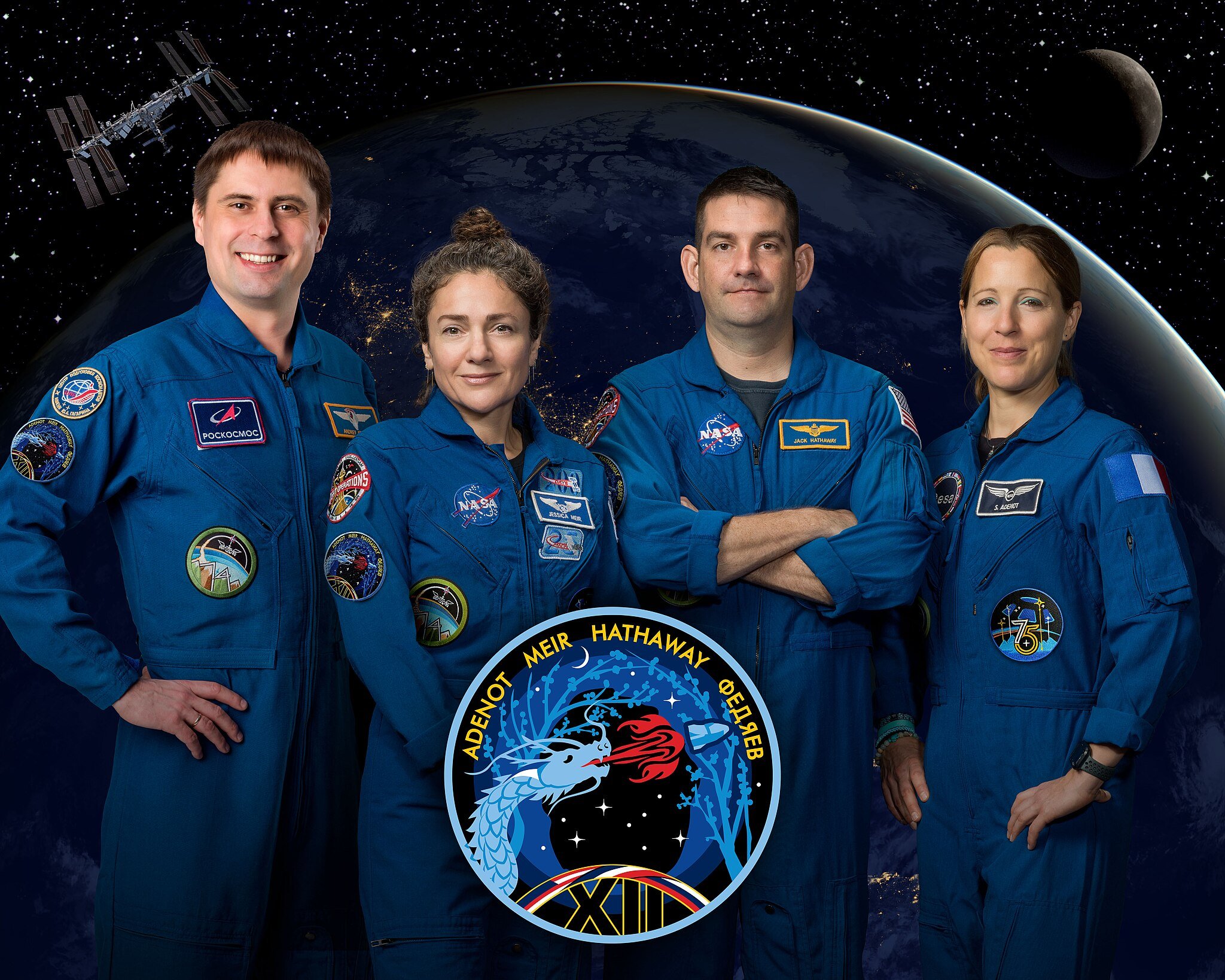
The four members of NASA's SpaceX Crew-12 mission to the International Space Station pose together for an official crew portrait. From left are, Roscosmos cosmonaut and Mission Specialist Andrey Fedyaev, NASA astronauts Jessica Meir and Jack Hathaway, Commander and Pilot respectively, and ESA (European Space Agency) astronaut and Mission Specialist Sophie Adenot. Image credit: NASA Johnson Space Center, Public domain, via Wikimedia Commons
In February 2026, a crew of four astronauts arrived at the International Space Station (ISS) via the SpaceX Dragon spacecraft to undertake an eight-month mission. Among the four is Sophie Adenot, the second French woman and eleventh French astronaut to go to space. Nearly 44 years after Jean-Loup Chrétien was chosen as the first Western European to launch into space with a Soviet team of cosmonauts on the Soyuz T-6 mission, Adenot is serving as a mission specialist with Russian Andrey Fedyaev alongside spacecraft commander Jessica Meir and pilot Jack Hathaway of the United States. This crew has joined Roscosmos cosmonauts Sergey Kud-Sverchkov and Sergei Mikaev and NASA flight engineer Chris Williams who have been aboard the ISS since December 2025.
Astronaut requirements are rigorous in nearly every possible aspect. Candidates must be in excellent physical and mental condition, hold an advanced degree or equivalent academic record in a scientific, technology, engineering, mathematics, and/or medical discipline, and have at least several years of professional experience in those fields or considerable experience as a pilot in high performance aircraft. Fluency in English and Russian contribute to effective teamwork while at the ISS as well as adaptability, focus, and resiliency under stress since astronauts must be away from family and typical supports for long periods of training and space flight. While at the ISS, astronauts live in tighter quarters while performing a range of duties, including maintenance and experiments, that may not always go as planned and require resourceful thinking and cooperation.

The Soyuz Taxi crewmembers in the Zvezda Service Module on the International Space Station (ISS) in October 2001. From the left are Flight Engineer Konstantin Kozeev, Commander Victor Afanasyev, and French Flight Engineer Claudie Haigneré. Image credit: NASA, Public domain, via Wikimedia Commons
Sophie Adenot was barely in her teens when she watched a launch broadcast of the Soyuz TM-24 to the Mir Space Station in the summer of 1996. Aboard were Valery Korzun and Alexsandr Kaleri of the USSR and Frenchwoman Claudie Haigneré (then André-Deshays). A practicing rheumatologist with a doctoral degree in neuroscience and certificates in a variety of medical specialties, in 1985 Haigneré was among seven people and the first physician to be selected for astronaut training by the French space organization Centre National d’Études Spatiales (CNES). After qualifying as an alternate for a mission in 1993, she began training in Russia the following year in preparation for the 1996 Cassiopeia mission during which Haigneré conducted biological and medical experiments in space over the course of more than two weeks. Haigneré has since served in an honorary and advisory capacity at the Cité de l’espace scientific discovery centre in Toulouse, was the first woman to command the re-entry of a Soyuz capsule to Earth in 1999, and returned to space as the flight engineer for the Andromeda mission to the ISS in 2001. Back on Earth, Haigneré remained deeply involved in biomedical, life sciences, and neurological experimentation and research.
She retired from the European Space Agency (ESA) in 2002 and continued to promote and support scientific research and public outreach in various capacities, including advisor to the Director General of the ESA, founding director of Universcience, a science and technology museum in Paris, member of astro- and aeronautical associations including the International Academy of Astronautics, and a minister delegate in the French government from 2002 through 2005. Haigneré has been recognized with medals of honor from the French and Russian governments for her professional contributions and achievements, and streets in French villages and an asteroid have been named in her honor (along with her spouse Jean-Pierre Haigneré, also a French astronaut).
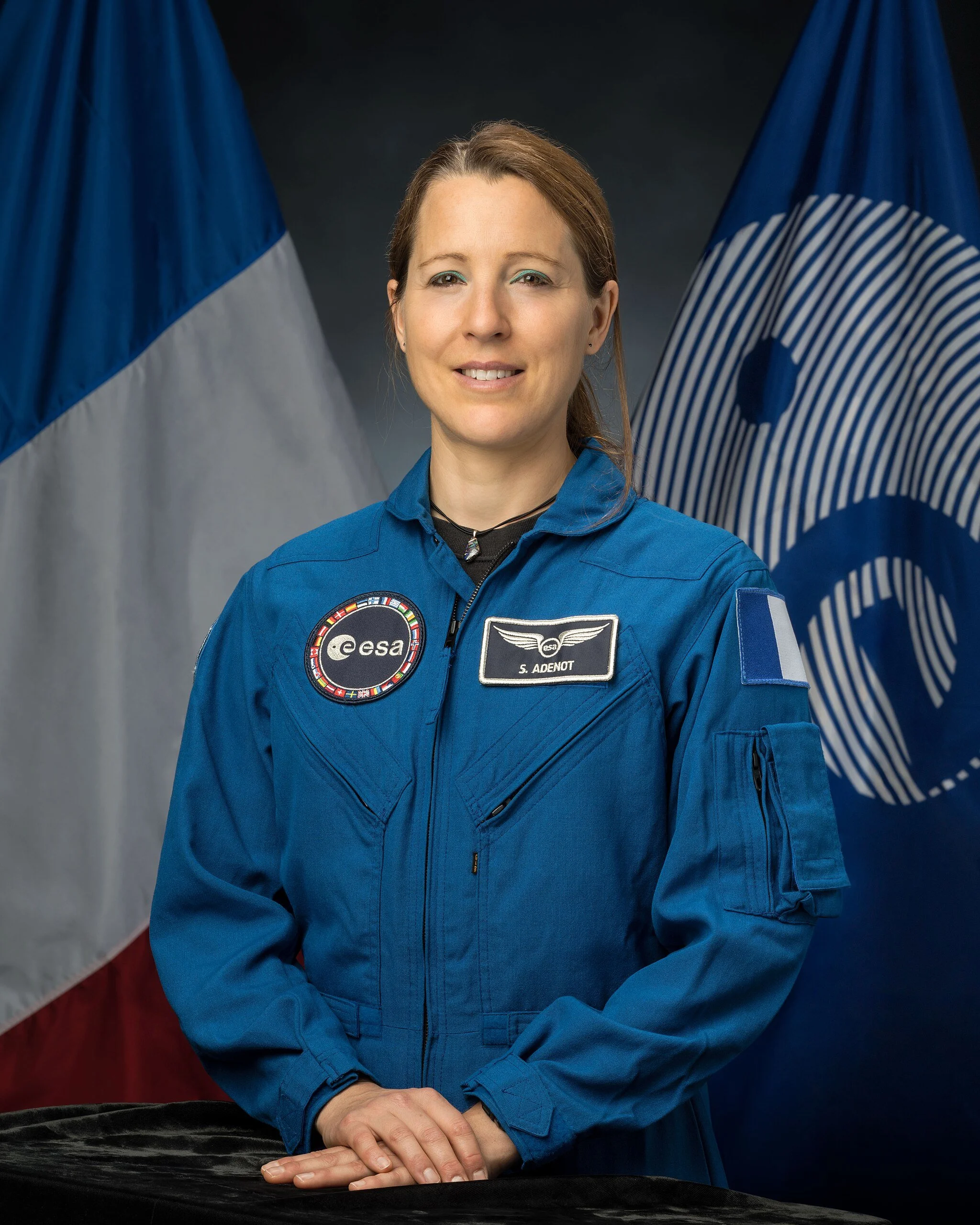
Official portrait of ESA (European Space Agency) astronaut and SpaceX Crew-12 member Sophie Adenot at NASA's Johnson Space Center in Houston, Texas (June 2025). Image credit: NASA Johnson Space Center / ROBERT MARKOWITZ NASA-JSC, Public domain, via Wikimedia Commons
Both Haigneré and Adenot are natives of the Bourgogne area who went on to study, work, and train elsewhere in France and abroad before going to space. While Haigneré was at work on the ISS in 2001, Adenot embarked on studies that culminated in an engineering degree from the Institut Supérieur de l'Aéronautique et de l'Espace in Toulouse followed by a master’s degree from the Massachusetts Institute of Technology in the United States. She designed helicopter cockpits for Airbus before following her grandfather’s footsteps by joining the French Air Force in 2005. Adenot served as a search-and-rescue helicopter pilot, formation flight leader and mission captain, and experimental test pilot in multiple countries, gaining considerable experience with different aircraft and flight situations while earning promotions to reach the rank of colonel in 2023. These experiences helped transform her initial rejection from the 2008 ESA Astronaut program into a place within the 2022 European Astronaut Corps which had received over 20,000 applications. Two years later, Adenot was named to the SpaceX Crew-12 group that recently arrived at the ISS.
Throughout the rest of 2026, Adenot will conduct some 200 experiments related to microgravity and its effects while on the ISS. Her research and that of the entire crew will inform future missions to the Moon and to Mars as well as providing insight for terrestrial projects. But her stay is not all work all the time. Adenot brought culinary reminders of home such as foie gras prepared by Michelin-starred French chef Anne-Sophie Pic and recordings of the sounds of nature on Earth. Adenot recently shared a video (in French and in English, two of the four languages that she speaks) from the ISS recounting her story, citing the influence of Claudie Haigneré and encouraging others, particularly girls and women, to pursue their goals by believing in their own capabilities.
Jeu de français
Click on the initial letter of each answer in the crossword puzzle below to view the clue in French. This game will test both your French and your knowledge of space exploration trivia.
Subscribe to our newsletter to receive Art de vivre posts, information about courses, Conversation Café, special events, and other news from l’Institut français d’Oak Park.