
La Suisse romande

Map of the geographical distribution of the official languages of Switzerland (2000), Swiss Federal Statistics Office. Image credit: Marco Zanoli, CC BY-SA 4.0, via Wikimedia Commons
Where in the Francophone world can one visit the former home of Charlie Chaplin, view one of the world’s tallest forks (sculpture), sample local cheese and delectable chocolate, and work off calories with a hike on mountains and near glacier-fed lakes? The answer is la Suisse romande, or Romandy, an unofficial region of Switzerland nestled against the east central part of France along the Alps. Nearly one-quarter of the country’s people live in Romandy and speak French as their native tongue. It is the official language in the cantons of Geneva, Jura, Neuchâtel, and Vaud and shares this status with German in Bern, Fribourg, and Valais. A colloquial term for the French-German divide is barrière de rösti, meaning the rösti ditch. It refers to the west-east linguistic divide but also applies to cultural stereotypes that differ between the Romands and die Deutschschweiz (German-speaking Switzerland).
True to its 13th century roots as a voluntary grouping of three cantons, the Swiss Confederation united 22 cantons under a federal government and constitution in 1848 while allowing them to maintain their distinct cultures. German, French, and Italian were recognized as national languages with Romansh added in 1938. It is thus not surprising that nearly two-thirds of Swiss people regularly use more than one language in their daily lives with a higher proportion of those under 24. Yet fully one quarter of Swiss adults 25 and over studies a new language for professional or personal reasons, a testament to the value of multilingualism within Swiss culture.
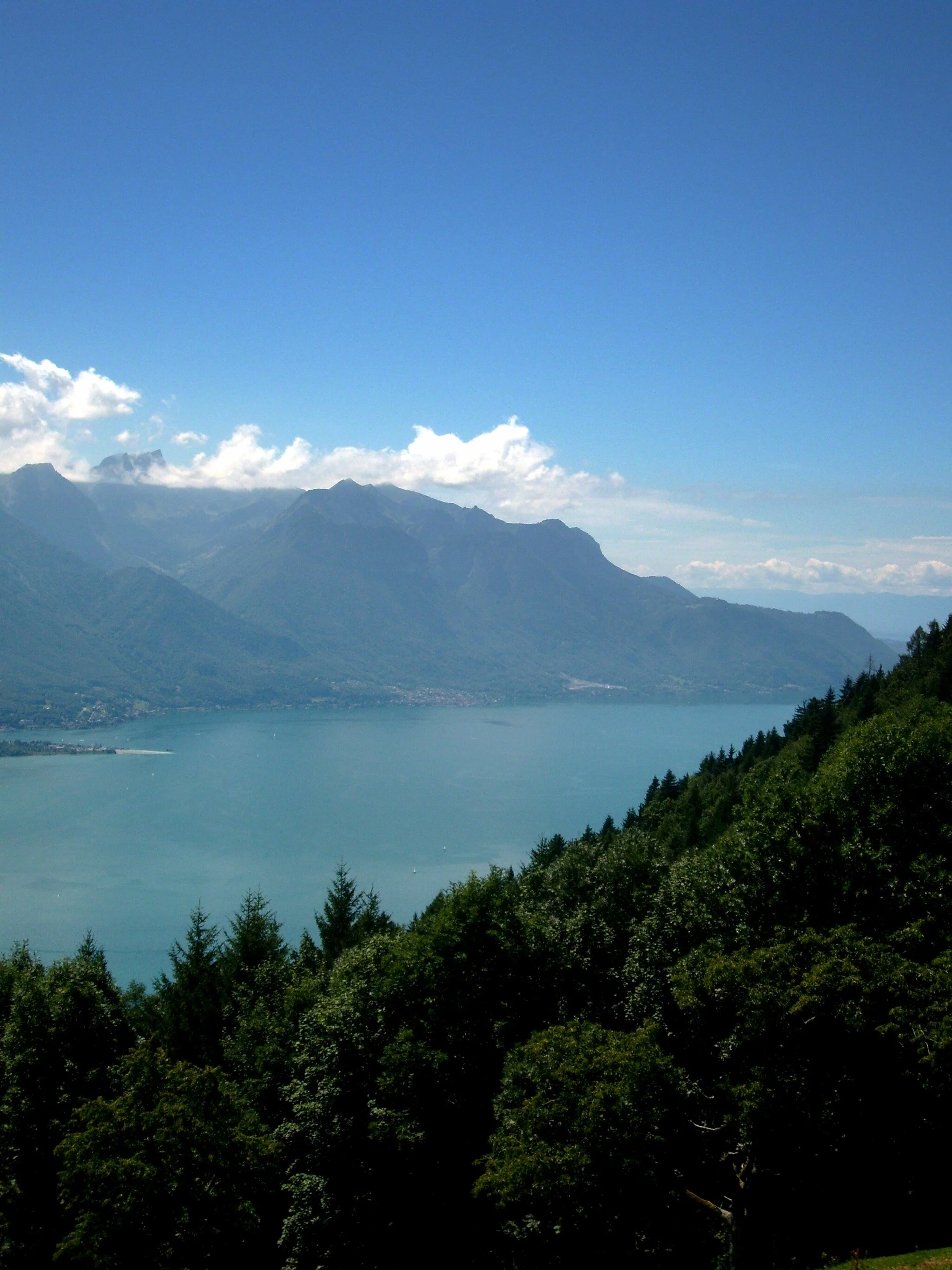
View over Lake Geneva (Lac Léman) near Caux, Switzerland. Image credit: Christopher Down, via Wikimedia Commons
Geneva, the largest city within Romandy, lies on the southern tip of Lac Léman (Lake Geneva). Like many of the communities in French-speaking Switzerland, Geneva benefits from a naturally picturesque setting with the lake and the Rhône and Arve rivers surrounded by mountain ranges of the Jura. It was the sometime home of John Calvin, a key figure in the Protestant Reformation during the 16th century, hosted the League of Nations formed in 1919, and is now the seat of the International Committee of the Red Cross, numerous United Nations agencies, and a global financial center.
Lausanne, the largest city within the canton of Vaud, also abuts Lac Léman on its northern shore. It is known as the Olympic Capital with the International Olympic Committee headquarters and nearby Musée Olympique steeped in all things current and past of the Games. Moving east from Lausanne, the headquarters of Nestlé is located in the Romande town of Vevey where La Fourchette, a sculpture created by Jean-Pierre Zaugg and C. Toda, rises over 25 feet from the lake. It was originally installed 30 years ago to commemorate the tenth anniversary of the Alimentarium, a museum dedicated to food and nutrition sponsored by a foundation established by Nestlé. Nearby in Corsier-sur-Vevey is Chaplin’s World, a museum in the Manoir de Ban where the iconic actor/filmmaker lived for a quarter century.
On the eastern end of Lac Léman, Montreux is famous for its annual summer jazz festival, lavish hotels, and historic castles such as the Château de Chillon. Another notable destination is the Queen Studio Experience in Mountain Studios, where the British rock band Queen recorded several albums. The studio is open to the public and filled with memorabilia as well as offering glimpses into the band’s recording environment. Montreux is also the starting point for the Golden Pass Belle Époque train that follows a scenic path in northeast to Zweisimmen in the Pays d’Enhaut.
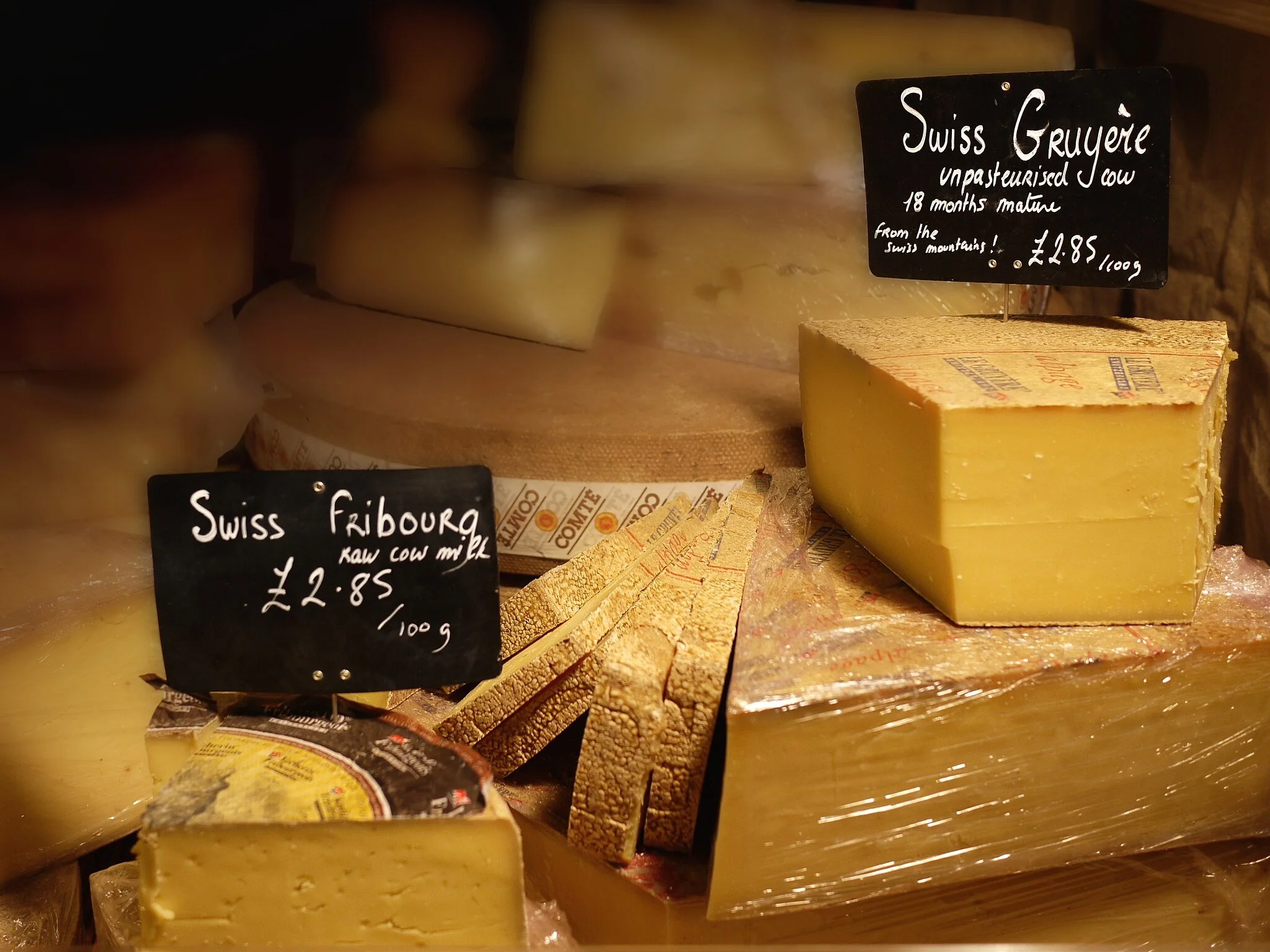
Vacherin Fribourgeois (AOP) and Gruyère (AOP) cheeses from western Switzerland. Image credit: Smabs Sputzer (1956-2017)Derivative work: Zacharie Grossen, CC BY 2.0, via Wikimedia Commons
Swiss Alpine roots endure beyond the urban centers of Romandy. Between Lausanne and Montreux, the Lavaux vineyards have spread across mountain terraces since the 12th century and are recognized as a UNESCO World Heritage site. The most commonly grown grape, Chasselas, produces a white wine that complements the cheese-based dishes of the area.
Another example is the désalpe, an autumnal tradition that has continued for thousands of years. Cows that sustain the robust Swiss dairy industry graze on meadow grass high in the mountains during the spring and summer months, returning to barns before the arrival of winter. This event is marked by festivals with traditional costumes and music, crafts, and food markets as well as the stars of the show – cows adorned with Alpine flowers and bells, accompanied by goats, sheep, and the herders and dogs who oversee them. Désalpes celebrations pay homage to Swiss culture and the connections among nature, humankind, and animals. Notable désalpes take place in Saint-Cergue, Crans-Montana, Charmey, where the event is known by its historical name of Rindyà, and other Romande communities.
Although la Suisse romande shares the common language of French, the Francophone areas of Switzerland exhibit a broad variety of characteristics. From urban to rural, internationally minded to staunchly traditional Swiss, historic to modern, and mountaintop to valley, the regions that comprise Romandie hold their own while contributing to the Swiss Confederation and the world beyond.
Activité de français
Experience several scenes from a recent désalpe in Saint-Cergues, including the cow parade, traditional dancing, and a range of musical performances complete with alphorns.
Subscribe to our newsletter to receive Art de vivre posts, information about courses, Conversation Café, special events, and other news from l’Institut français d’Oak Park.