

The Gallic Rooster: From Roman Mockery to French Emblem
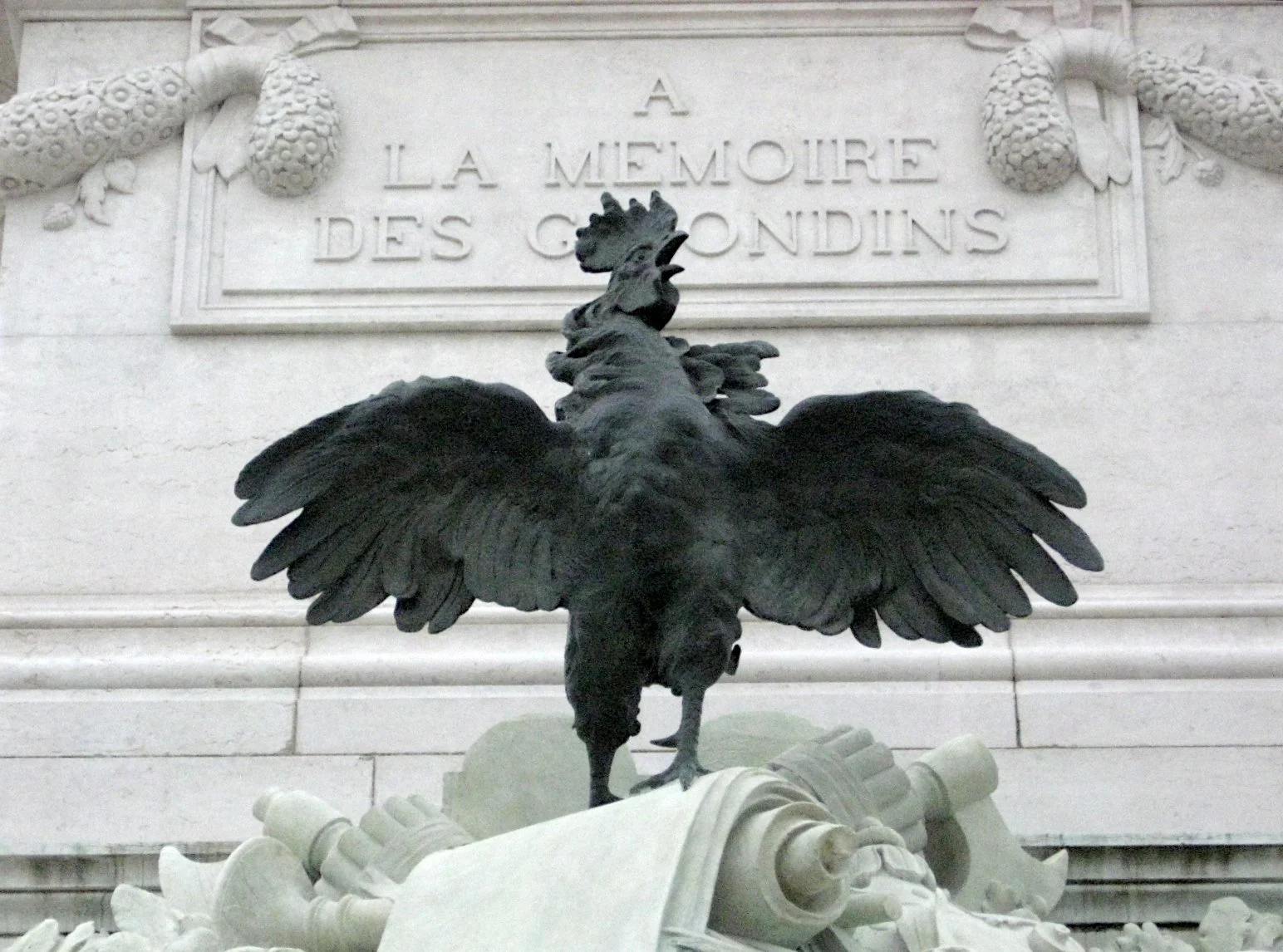
Coq gaulois de la statue des Girondins place des Quinconces à Bordeaux by Jean-Marie DAVID, March 2008 — Source : Wikimedia Commons / Domaine public
An eagle for Germany, a lion for England, a bull for Spain, and a rooster for France. Few animals are as closely tied to a national identity as the coq gaulois, the Gallic rooster, one of the most famous unofficial emblems of France.
Born of a historical pun and transformed over the centuries into a symbol of national pride, it adorns coins, flags, war memorials, and athletes’ jerseys. Understanding its history requires delving into the cultural, political, and religious roots of France, and the bird’s journey from mockery to emblem says as much about how nations choose their symbols as it does about the animal itself.
The story begins in Antiquity, with a play on words. In Latin, the term gallus means both “rooster” and “inhabitant of Gaul,” the Celtic territory that roughly corresponds to present-day France. The rooster was probably not chosen by the Gauls themselves but by their Roman adversaries. The comparison was meant to be derogatory: it mocked the disorder of the Gauls and the cry they uttered in battle, which was thought to resemble a rooster’s crow. Although a rooster does appear on some Gaulish coins, historians point out that there is no proof it served as a Gaulish standard, and Renaissance scholars later mistakenly imagined it as an emblem predating the Roman conquest. The barnyard bird, a familiar presence on rural farms, nevertheless carried positive connotations: as a vigilant guardian that announced the dawn each morning, it evoked perseverance, courage, and light, qualities that would later help turn mockery into pride.
This transformation was slow. In the Middle Ages, the rooster was more often a weapon of ridicule than a badge of honor. According to some accounts, neighboring peoples used the Latin pun to mock the kings of France, with Philippe Auguste compared in the twelfth century to a proud barnyard fowl, and the animal was seen as quarrelsome, arrogant, and boastful. By the fourteenth century, however, the situation began to reverse. The rooster was accepted first in royal circles, then among the wider population, and from the Renaissance onward it appeared in representations of the king, on coins and on seals. The French sovereigns, in effect, turned the insult around, making the rooster a figure of audacity, courage, and combativeness.
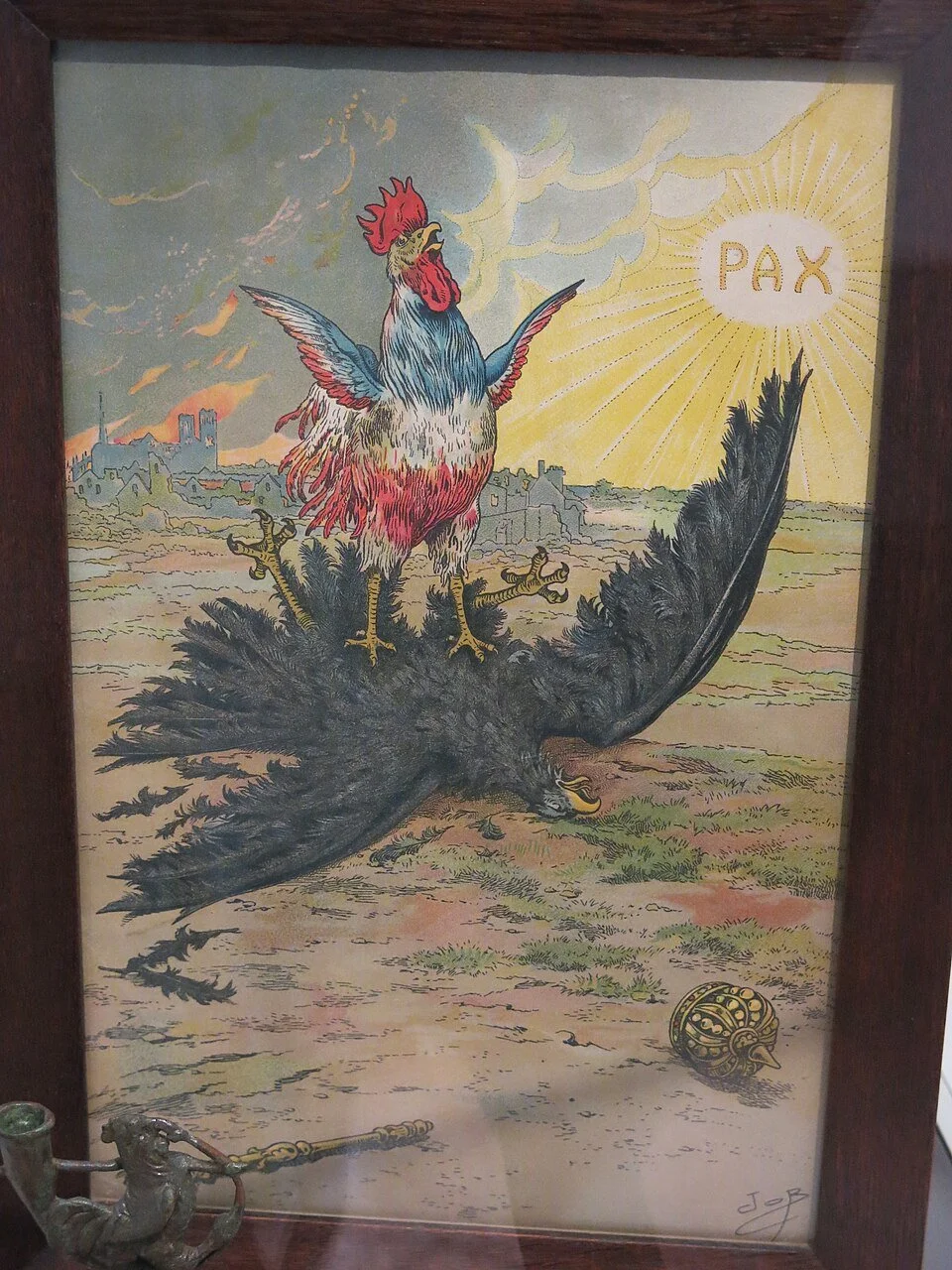
Affiche de propagande montrant le coq francais vainqueur de l'aigle allemand. Auteur : Job (Jacques Onfroy de Bréville, 1858-1931) /Source : by Tangopaso via Wikimedia Commons
Religion played a decisive role in this rehabilitation. In the New Testament, the rooster appears in the episode of Peter’s denial. Jesus tells the apostle that he will deny him three times before the rooster crows, and the animal thus became a Christian symbol of vigilance, repentance, and resurrection. As the bird that announces the day and drives away the night, it came to be placed atop church steeples across Christian Europe, where it watches over the faithful and protects them from the forces of darkness. The kings of France drew on this association to strengthen their image as protectors of Christendom. Some accounts also link the rooster, which greets the sun every morning, to Louis XIV, the Sun King, who is said to have associated the bird with his own image. The fleur-de-lis nevertheless remained the monarchy’s principal emblem, and the rooster held only a secondary place in the collective imagination.
The French Revolution of 1789 marked a decisive turning point. With the fall of the monarchy, the revolutionaries rejected royal symbols such as the fleur-de-lis and sought new emblems for the nascent Republic. France then discarded nearly all the old emblems of the monarchy, with the exception of the color blue and the figure of the rooster. A symbol both ancient and close to ordinary people, the animal became the emblem of a vigilant and combative populace, and its crest was sometimes likened to the Phrygian cap worn by the revolutionaries. It even appeared on the seal of the Directory, the government that ruled France from 1795 to 1799. When Napoleon Bonaparte sought an emblem for the empire he was about to found, a commission of State Councillors proposed the rooster, but he refused. He preferred the eagle, the imperial bird inherited from ancient Rome.
The rooster waited patiently. On July 30, 1830, shortly after the revolution that placed Louis-Philippe on the throne, a royal ordinance decreed that it should appear on the uniform buttons of the National Guard and atop its flags. The Second Republic, established in 1848, placed it on its seal, engraved on the rudder held by a seated figure of Liberty. Napoleon III in turn disdained it, but the bird enjoyed its finest hour under the Third Republic, which featured it on its seal and its gold coins and set it, wings spread and spurs raised, at the top of the gate of the Élysée Palace, the residence of the President of the Republic, where it still stands today.
The twentieth century gave the rooster a new and more combative role. During the First World War, it appeared on propaganda posters facing the eagle of Prussia, which had become the German Reich, a confrontation that made the two birds representatives of the two nations. After the war, many French war memorials were surmounted by a rooster, which thus became a symbol of remembrance as much as of defiance. In the following decades, it also found its place on the playing field: it adorns the jerseys of the national teams in football, rugby, and other sports, where it embodies fighting spirit, endurance, and the hope of the nation.


Charles Vareilles en équipe de France de rugby en 1908 / Source : by DarkFérosinge via Wikimedia Commons
Despite its ubiquity, the rooster has never been an official symbol of the French Republic. Unlike the tricolor flag and the national anthem, which are named in the Constitution, it has no constitutional status, and in the political sphere it has long been overshadowed by Marianne, the allegorical figure of the Republic. It endures nevertheless through the sheer force of custom. It appears on war memorials, on the facades of certain town halls, on postage stamps, and in the logo of La French Tech, the public initiative that promotes French start-ups. It has also become a commercial emblem.
Today, the Gallic rooster remains a powerful symbol of French identity, and it has evolved with the times. It is no longer only an emblem of combat. It also evokes elegance and refinement, and it represents a France proud of its roots yet turned toward the future. Having embodied faith, combativeness, hope, and endurance across the centuries, it reflects both the diversity and the unity of the French nation. In a globalized society, it serves as a bridge between tradition and modernity, able to respond to contemporary aspirations while honoring the heritage of the past, and its history serves as a reminder that national emblems are often the product of historical accidents and shifting interpretations rather than deliberate and unambiguous choices.
Jeu de français
Ready to test what you've learned about La Marseillaise, the Gallic Rooster, and test your knowledge on other French emblems? Play the quiz below!
Subscribe to our newsletter to receive Art de vivre posts, information about courses, Conversation Café, special events, and other news from l’Institut français d’Oak Park.