

Take a Ride on the Rails
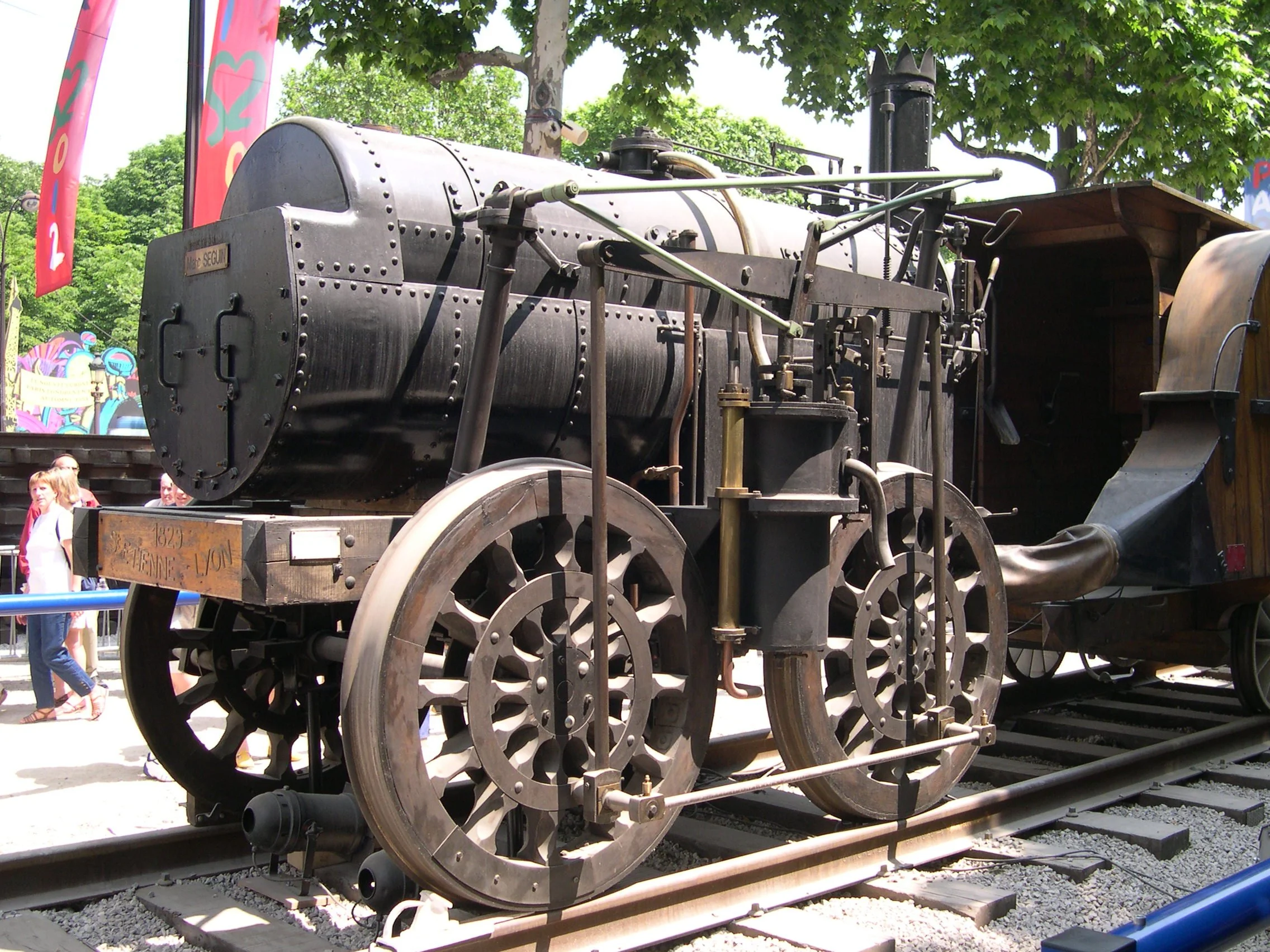
Replica of 1829 locomotive Marc Seguin at the Champs Elysées Expo Train Capitale, Paris, 2003. Image credit: GIRAUD Patrick, CC BY-SA 3.0, via Wikimedia Commons
Paris is the political, economic, and cultural capital of France but there is much to see, do, and explore across the rest of the country. For nearly two centuries, French railways have offered a means of transport for people and goods to move from one area to another. The first line in 1827 spanned about 20km between Saint-Étienne and Andrézieux in the Loire Valley to move coal to the Loire River. Successive French governments encouraged private development of quasi-local rail companies which sprung up over the ensuing decades but struggled to maintain economic viability. In 1878, the French Third Republic started to consolidate these under the umbrella of the Administration des chemins de fer de l'État, which evolved into the Société Nationale des Chemins de fer Français (SNCF) in 1938 by nationalizing railways across France. Rail transport was instrumental during World War II; however, extensive damage from intensive usage, limited maintenance, and wartime activities required significant investment afterward. At the same time, the rise of automobile and bus transportation along with state development of roadways presented competitive pressures that resulted in a negative impact on the rural rail segment, which began to shrink.
France focused on the development and adoption of transportation technology to facilitate connections among major towns and cities while providing attractive alternatives to car, bus and truck travel that would add to congestion and pollution. After seeing the engineering marvel and commercial success of the Tokaido Shinkansen high speed train in Japan, France began development of its own high-speed rail during the 1970s. The result was the introduction of the Train à Grande Vitesse (TGV) between Paris and Lyon in 1981, one of the first high-speed trains in Europe. Additional destinations and routes were added within France and neighboring countries began discussions to extend TGV service across borders. The Eurostar between Paris and London went into service in 1994, followed by Thalys soon afterward connecting Paris with Brussels and Amsterdam. The TGV carried approximately 168 million passengers in 2025 and service now runs on nearly 30,000 km of tracks that link over 200 towns and cities throughout France and Western Europe.

TGV Duplex on the LGV Méditerranée line, Vaucluse. France. Image credit: jean-louis Zimmermann, CC BY 2.0, via Wikimedia Commons
The TGV holds the world speed record of 574.8 km/h (~357 mph) for conventional passenger trains whereas regular service operates at speeds up to 300-320 km/h (186-199 mph). Its railcars and equipment are manufactured by French company Alstom S.A. which generates €18.5 bn of annual revenue from rail transport customers in France and around the world. Since its introduction nearly 45 years ago, the TGV has recorded an excellent safety record with zero accidents during regular high-speed service and a handful of level crossing accidents on the classic lines. Relative to the billions of passenger-kilometers covered every year, the TGV compares very favorably to automobile travel accident and casualty records.
The SNCF’s record on the environmental front is also commendable with just over half of total track length currently electrified and strategic deployment of technology and equipment that advances the SNCF’s goal of achieving net-zero emissions by 2050. Just as coal-powered steam engines of the 19th century gave way to diesel fuel in the 20th across the rail industry worldwide, the SNCF has adapted its operations when feasible to test and then implement more efficient and sustainable elements to specific areas of its network. For example, the early years of electrified trains required an overhead line that largely limited usage to subway and tram services within large cities. The introduction of an electrified third rail provided a solution for major intercity routes, but its cost and construction requirements were prohibitive for modifying the entire country’s railways. Battery technology has advanced sufficiently to be put in place for trains to traverse shorter routes without much more expensive and time-consuming infrastructure changes. The combination of speed, safety, and an ecological impact that is significantly lower per passenger than air and road travel help sustain train ridership within France and into nearby countries, although the growth of low-cost European air travel and the personal convenience of road vehicles contribute to a competitive travel landscape.
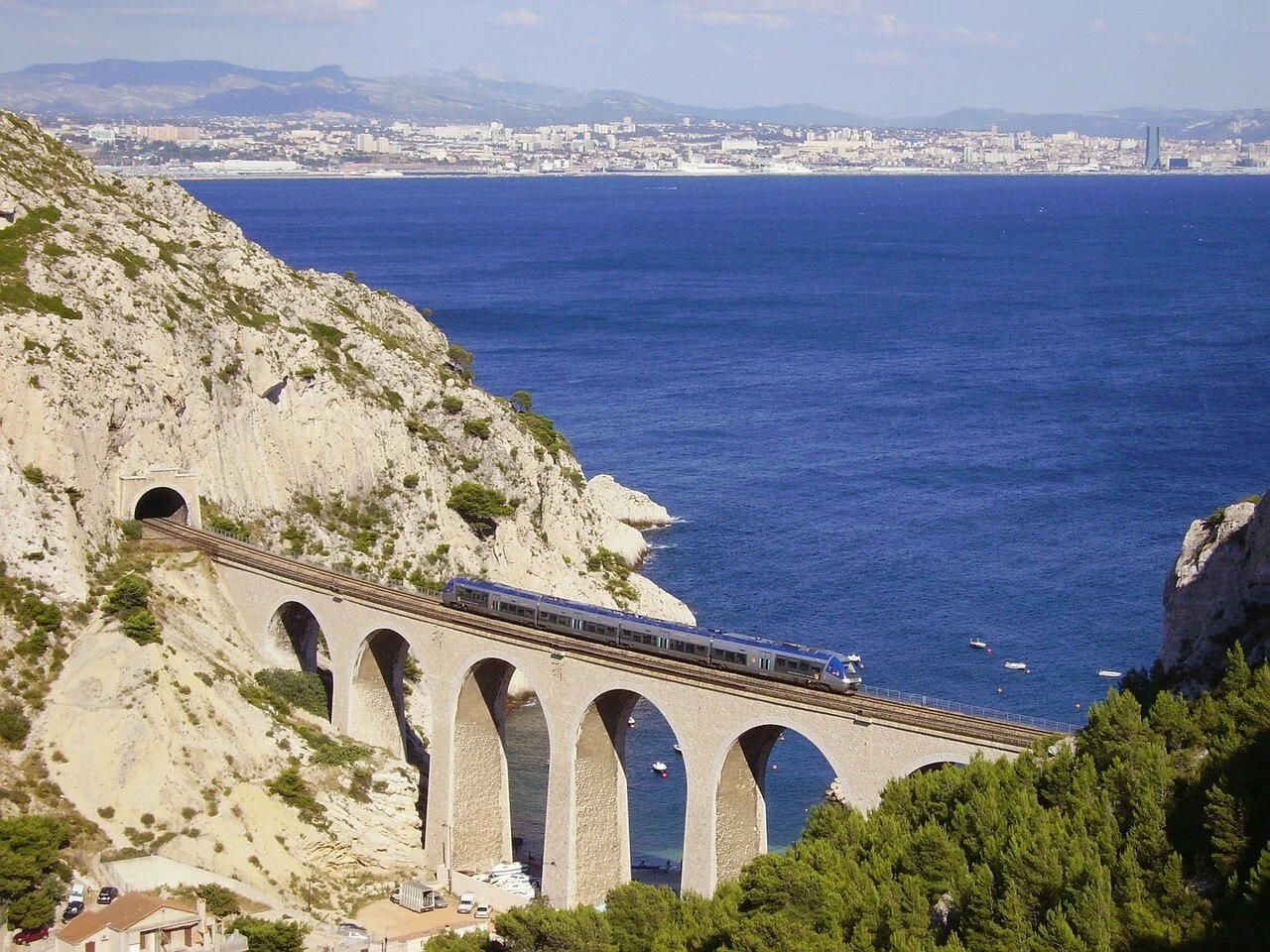
A TER train from Marseille to Miramas on the viaduct of La Vesse, July 23, 2010, France. Image credit: Didier Duforest, CC BY-SA 3.0, via Wikimedia Commons
The French rail network overall ranks among the ten largest in the world despite the country’s relatively small geographical size. Cities served by TGV lines are linked to regionally operated Transport Express Régional (TER) networks in eleven sections of France. These are often used by commuters within a region and by tourists, particularly on a range of dedicated routes that take people closer to small towns and areas that showcase the natural beauty of France.
The Côte Bleue train leaves the bustle of Marseille to follow the Mediterranean coast along the bay and beaches while overlooking harbors that evoke the area’s fishing and maritime history. Farther east in Provence-Alpes-Côte d’Azur is the Train des Merveilles that transports passengers from the Nice seaside to the trees and villages of the Alps on the way to the village of Tende. Stops along the way provide opportunities to hike, explore, visit museums and historic structures, and enjoy nature, including access to Mercantour National Park. On the opposite side of southern France near the Spanish border, the Ligne de Cerdagne known as the Train Jaune reaches over 5,000 feet in the Pyrenées mountains. Built over a century ago to connect isolated mountain dwellers, the Train Jaune still serves as a reliable alternative to roads that occasionally are snowed in or blocked by landslides. Its completion required not only rail expertise but the engineering and construction of several bridges and the Bouillouses Dam to generate hydroelectricity for the train itself.
Travel within France benefits from a variety of options and the high cost of railway maintenance and development weighs on the public purse; however, train travel is embedded in French history and culture while continuing to serve as an attractive method of transportation in multiple aspects. Coordination with other European nations and continued investment in technology, safety, and environmentally friendly measures enhance the customer experience to keep passengers returning despite competition from alternatives. France also benefits from its breadth of expertise and experience that should position it well to maintain its prominence and effectiveness in providing comprehensive rail transportation for years to come.
Jeu de français
Would you be able to find your way onto a TGV in France using relevant French vocabulary? Test yourself, or learn a few new terms, by clicking below and ‘Start quiz’. Each question begins with a short scenario in a train station followed by a sentence with a clue in English for the missing French word(s) for you to fill in.
Subscribe to our newsletter to receive Art de vivre posts, information about courses, Conversation Café, special events, and other news from l’Institut français d’Oak Park.