
The Paris Métro
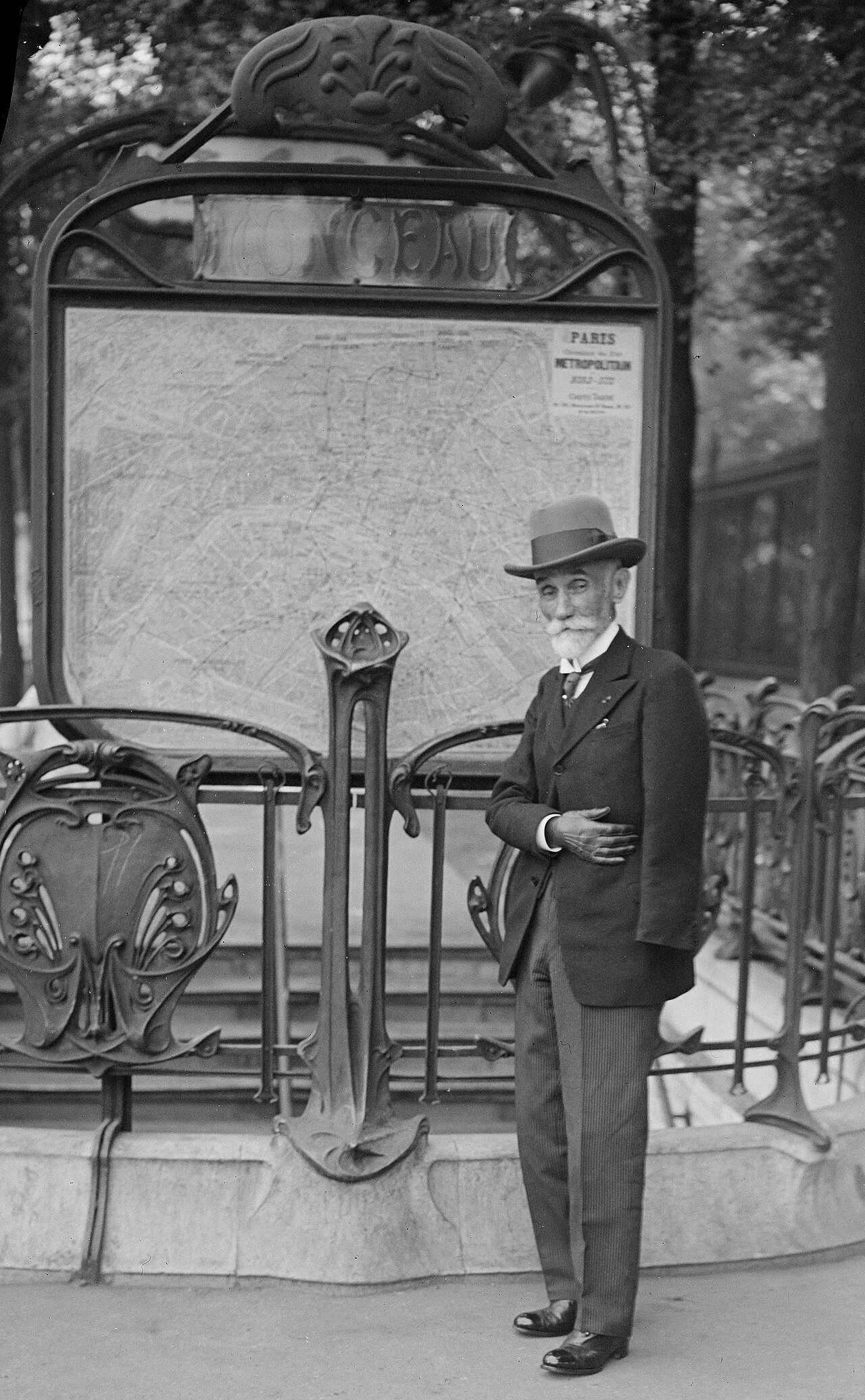
Fulgence Bienvenüe (1852-1936), Father of the Parisian Métro, by the entrance to the Monceau station. Image credit: User TiFraiz on fr.wikipedia, Public domain, via Wikimedia Commons
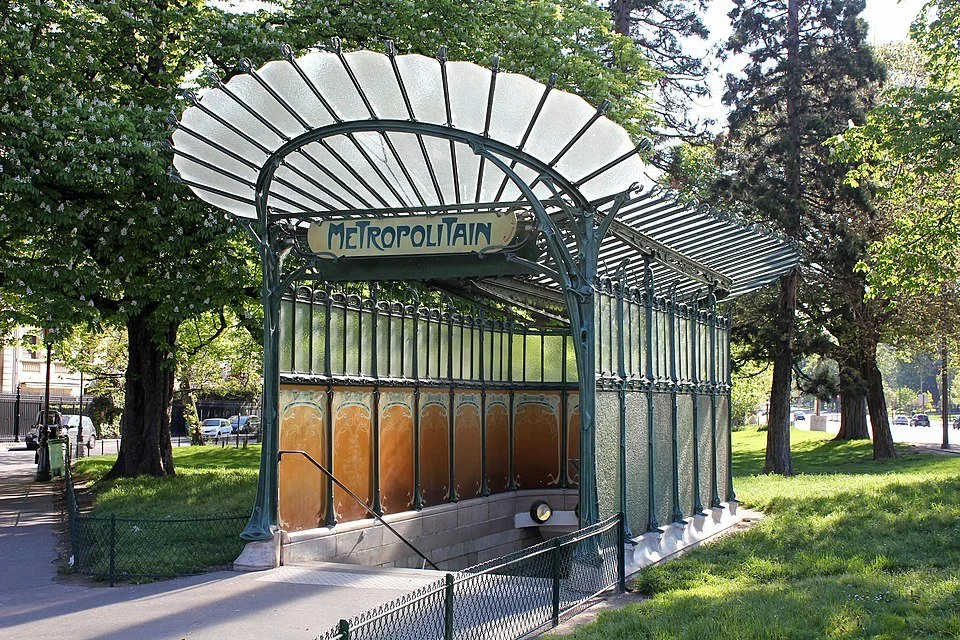
It is nearly impossible and highly impractical to spend a few days or longer in Paris without riding on its iconic subway system known as the Métro . In operation since 1925 and now numbering over 300 stations, the Métro moves approximately four million passengers per day and some 1.5 billion riders per year throughout Paris as well as connecting to suburban, intercity, and international trains and other modes of transportation. The Paris Métro consistently achieves its original designers’ goal of alleviating city surface congestion and has become a key element of Parisian daily life and culture. Overcoming construction, engineering, and financial challenges, the utility of the Métro has steadily been maintained and expanded while incorporating visual artistic appeal via the Art Nouveau entrances of Hector Guimard above ground and distinct touches at the rail level.
Paris in the late 19th century was a vibrant and changing metropolis. Challenges to the Third Republic after its installation in September 1870 included the Franco-Prussian War, the Paris Commune, the threat of a government takeover by French Minister of War Georges Boulanger, and waves of social unrest. Yet its dynamism was evident in the evolving Parisian landscape with the construction of the Palais Garnier and Eiffel Tower and the restoration of buildings damaged by the Communards, such as the Hôtel de Ville and Palais de Justice. Arts and entertainment options expanded for those with means in the forms of art exhibitions, musical performances, restaurants, and fashion that were gaining prominence in Paris. The city drew crowds to its Exposition Universelle de 1878 and another in 1889. As plans unfolded for Paris to host the 1900 World’s Fair and Summer Olympic Games, it was increasingly obvious that the already jam-packed city streets were ill-suited to handle the influx of visitors.
Civil engineer Fulgence Bienvenüe was appointed by city officials in 1896 to oversee the design and construction of an underground transport system in the face of skepticism and outright opposition. Two years later, excavation amid rerouted thoroughfares and sewer pipes began on a ten-kilometer length between Porte Maillot to the west and Château de Vincennes to the east. Under Bienvenüe’s direction, the successful creation of Line 1 led to work on additional tunnels and tracks that gave rise to additional obstacles, most notably a devastating fire in 1903 that took 84 lives. However, the tragedy prompted revisions in safety standards that were embedded into new development rather than stopping expansion. Bienvenüe’s initial design of ten lines crisscrossing Paris was refined as lessons were learned during construction, and nearly the entire plan was built out by the 1920s. A competing company called the Nord-Sud built out two lines before going bankrupt and being consolidated into the Bienvenüe system in 1930. To the chagrin of some and delight of others, many metro stations were adorned with a distinctive entrance designed by Hector Guimard in the Art Nouveau style with lettering that Guimard created, whereas the Nord-Sud stations sported signposts topped with ‘MÉTRO’ in block lettering that has since been updated to a simple ‘M’ in many locations.
During World War II, the Métro reduced service, closed several stations, and served as bomb shelters as well as a conduit for Resistance fighters. Post-war, its operations were combined with the bus system under the umbrella of the RATP (Régie autonome des transports parisiens), which updated signal and train technology and linked suburban RER (Réseau Express Régional) and metro lines to provide travel connections more seamlessly throughout the expanding Parisian metropolitan area. The Métro grew to include 16 lines with nearly all stations less than 500 meters away from another. Five RER lines currently provide access into Paris where riders can disembark at key locations such as Charles de Gaulle-Étoile, Les Halles, and Gare de Lyon, one of the six intercity train stations in Paris. Its reach across the metropolitan area and convenience as an alternative to congested roadways have made the Métro indispensable to Parisians and visitors alike. However, the older stations are largely ill-suited for universal access although newer construction, such as line 14, are designed to be fully accessible. The Paralympic Games in 2024 helped prompt a project to reimagine making the rest of the Métro fully accessible, an echo of the 1900 Olympic Games serving as a catalyst for the original construction of the Métro.
Most of the Métro stations are lined with classic white subway tiles on the walls and arches of the tunnels and the signage typically displays station names, line endpoints, and line numbers in a color-coded sans-serif font. The first standardization initiative began in 1973 with the Métro Alphabet font by Adrian Frutiger that is still in use, although the RATP commissioned Jean-François Porchez to create a new font called Parisine that was introduced in 1997 and is gradually replacing all RATP signage. About one-tenth of Métro stations depart from these conventions to reflect specific features associated with their locations. The Louvre-Rivoli stop on line 1 in the 1st arrondissement of central Paris is one of the oldest metro stations, having entered service as the Louvre stop in August 1900. Growing numbers of tourists and the prominence of the Louvre Museum as a destination prompted the transformation of this station into an extension of the museum itself by carving out niches in the walls to house reproductions of selected original works of art. In contrast to most metro station walls that are covered with advertising, the Louvre-Rivoli platforms are ad-free to allow riders to focus on the artworks. This integration of fine art and a public space frequented by people from all walks of life pulls together two different yet distinctly Parisian elements, providing a reminder that art need not be limited to specific exhibition spaces and can be made available to all.
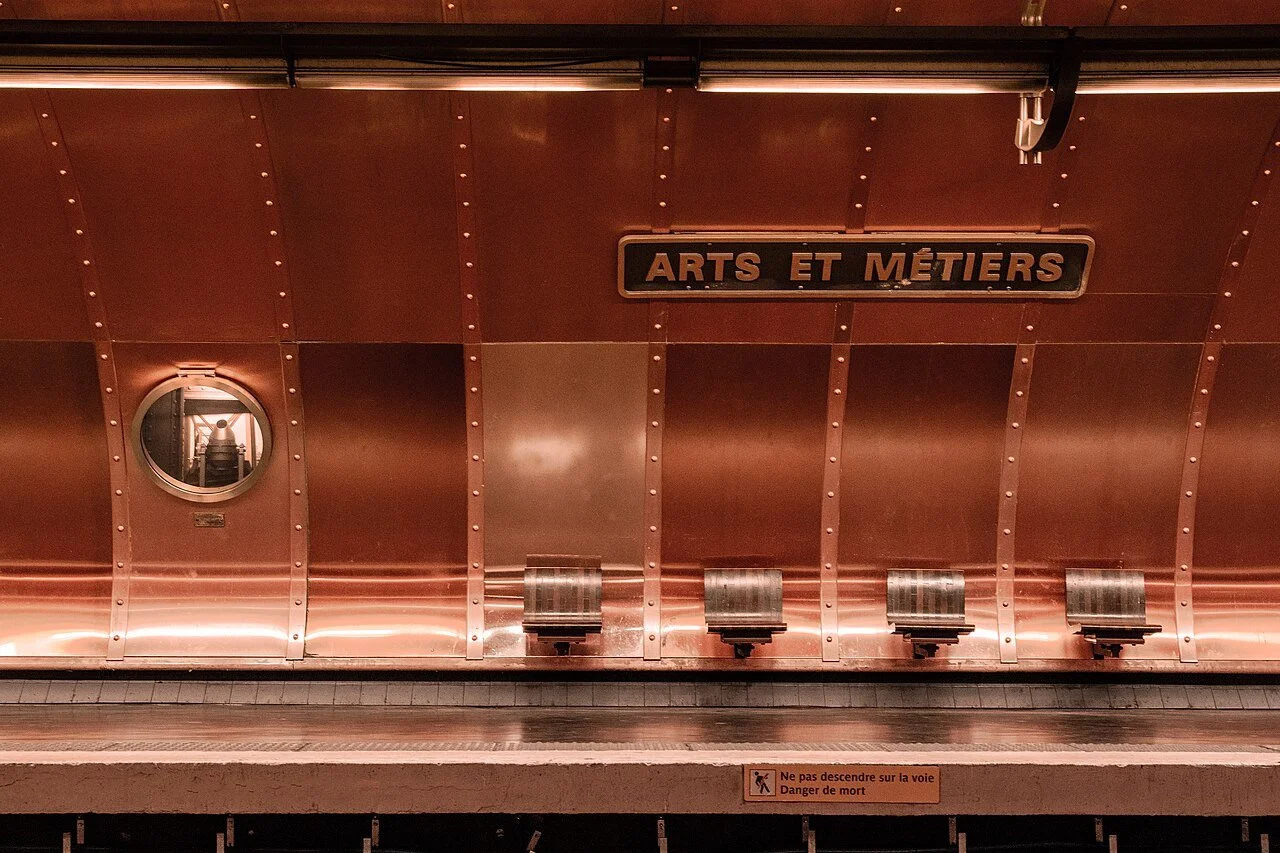
Arts et Métiers metro station on line 11, Paris, France. Image credit: Jerem9211, CC BY-SA 4.0, via Wikimedia Commons
Another example of a unique metro station lies northwest of the Louvre-Rivoli stop on lines 3 and 11 in the 3rd arrondissement. The Arts et Métiers station opened in October 1904 as part of line 3 in the original Bienvenüe system. In recognition of the 200th anniversary of the founding of the prestigious Conservatoire national des arts et métiers (National Conservatory of Arts and Crafts, now also a museum) in 1994, its namesake metro station was renovated to evoke images from “Twenty Thousand Leagues Under the Sea” by Jules Verne and pay homage to the 19th-century steampunk movement. The walls were covered with riveted copper plates bearing portholes with scenes that reflect items in the museum’s collections, and cogs and wheels were added to the tunnel ceilings to create a submarine environment. Other Métro stations depart from the standard look and feel throughout the system such as Bastille, with historical artifacts and scenes from the French Revolution, and Cluny-La Sorbonne, which is decorated with reproductions of the signatures of notable writers, scientists, philosophers, and other historical figures interspersed with mosaics by Jean René Bazaine, a French painter.
As the Paris Métro steadfastly delivers passengers throughout Paris and to connection points that carry them farther afield, it continues to evolve by extending its geographical reach, upgrading train cars and signaling, and incorporating new technology. Line 1 became the first fully automated (driverless) line between 2007 and 2013, followed by line 4 between Porte de Clignancourt and Bagneux-Lucie Aubrac, whereas newer lines have been constructed with automated operations from the start. The newer lines are also equipped with platform doors that serve as safety measures. The RATP is currently rolling out its Grand Paris Express project to connect underserved areas to job sites, cultural attractions, educational institutions, and other transportation hubs with four new subway lines and the extension of line 14. Grand Paris Express employs modern, environmentally-friendly technology that befits the Paris Métro’s 125 years of engineering and visual appeal to deliver an essential public service.
Jeu de français
The next time you visit Paris or watch a film or show that includes scenes from its extensive Métro system, consider the teamwork that has gone into its inception and development. Its dual role as a facilitator of transportation within and around a major European metropolis and an integral part of Parisian and French identity reflect the French aptitude for design and engineering combined with nods to history and society. Try the word search of station names by clicking below to (re)familiarize yourself with the places you can encounter while taking the Paris Métro.
Subscribe to our newsletter to receive Art de vivre posts, information about courses, Conversation Café, special events, and other news from l’Institut français d’Oak Park.